

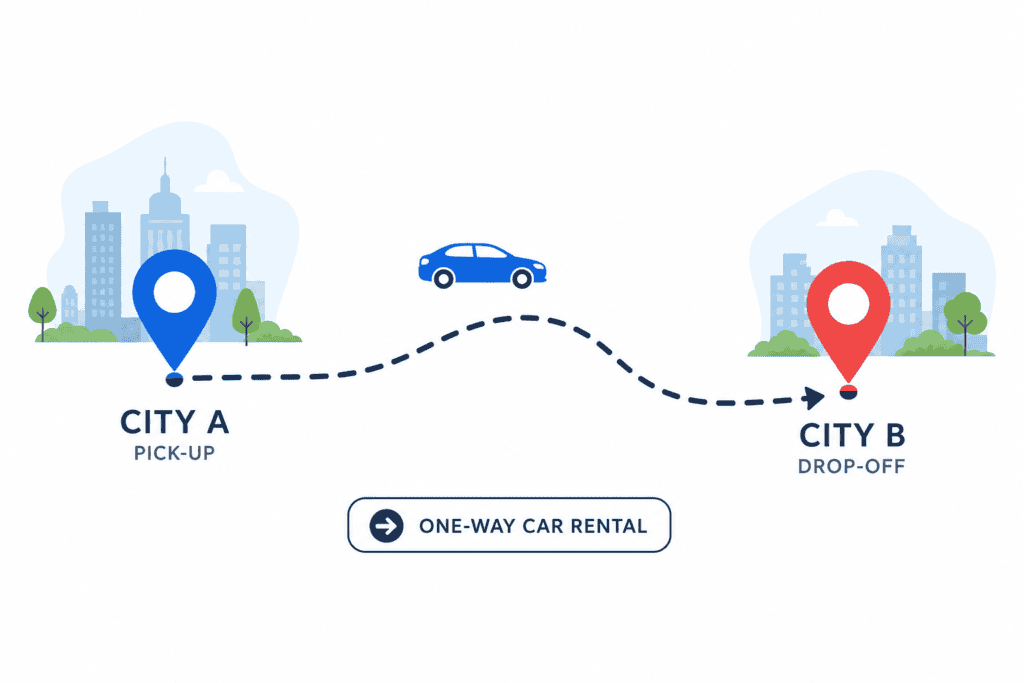
Renting a car in one city and returning it in another can be a practical solution for road trips, one-way flights, or multi-stop itineraries. But a one-way rental doesn’t always price the same as a standard round-trip rental, and the difference can vary widely depending on the company, the locations involved, and the vehicle you choose. Understanding what drives one-way pricing helps you avoid surprises and compare offers more accurately.
This article focuses specifically on rentals where the pickup and return locations are different, and how to approach that type of rental to keep the total cost reasonable. For broader strategies on finding an affordable rental in general, see how to find cheap car rentals without overpaying.
Quick Answer
One-way rentals can cost more than round-trip rentals because some companies charge a drop fee or price the rental based on vehicle relocation needs, but this isn’t universal. Costs depend on the specific pickup and return locations, vehicle category, dates, and company. Compare multiple companies and location pairs, since drop charges vary widely and some routes carry little or no extra charge at all.
Why One-Way Rentals Are Priced Differently
Rental companies manage a fleet of vehicles across multiple locations, and they generally want cars to end up where local demand exists. When you pick up a car in one city and drop it off in another, the company may need to move that vehicle back, or it may benefit from having it in the new location. Depending on which scenario applies, pricing can go up, stay about the same, or occasionally even work in the traveler’s favor.
This is different from a simple daily rate calculation. A one-way rental’s total price often reflects fleet logistics as much as it reflects the length of your trip. That’s part of why one-way pricing can feel unpredictable compared to a standard rental with the same pickup and return location.
What Affects One-Way Rental Cost
Several factors influence whether a one-way rental carries an added charge and how large that charge might be:
- Pickup and return location pair. Some city-to-city or airport-to-airport combinations are common routes for a company’s fleet and may be priced more favorably than unusual pairings.
- Vehicle category. Popular vehicle classes may move differently than specialty or larger vehicles, which can affect one-way availability and pricing.
- Rental company. Drop charges, if any, vary by company and are not standardized across the industry.
- Dates and demand. A route with high demand in the destination city may be priced differently than a low-demand return location.
- Distance and region. Longer distances or routes that cross regional or company-specific boundaries can sometimes affect pricing or availability.
- Rental duration. A very short one-way rental over a long distance may be handled differently than a multi-week rental with a distant drop-off.
Because these variables interact, it’s not accurate to assume every one-way rental includes a drop fee, or that the fee (when one exists) is a fixed amount. Always check the specific quote for your dates and locations.
Airport-to-Airport vs. City-to-City One-Way Rentals
The pickup and return location type can influence both price and convenience.
Airport-to-airport rentals are often straightforward for travelers flying in and out, but airport locations may include their own facility or concession-related charges in addition to any one-way pricing. If airport costs are a significant part of your decision, it can help to review airport car rental savings strategies alongside your one-way comparison.
City-to-city or neighborhood-location rentals may have different fee structures than airport locations, and availability for one-way returns can vary by office. A downtown or neighborhood location might not always support the same drop-off flexibility as a major airport hub, so confirm that your intended return location can actually accept the vehicle before booking.
Comparing One-Way Rental Offers
When you’re evaluating a one-way rental, treat it like any other rental comparison, but pay close attention to the location-specific line items. Use the same core comparison approach described in how to compare car rental prices the smart way, then add these one-way-specific checks:
| Factor | Rental A | Rental B | What to Compare |
|---|---|---|---|
| Base rate | Lower | Higher | Starting price only, before added charges |
| One-way/drop charge | Charged | Not disclosed | Confirm whether a charge applies at all |
| Pickup/return location type | Airport | Neighborhood | Check facility charges and transportation needs |
| Vehicle category | Midsize | SUV | Compare equivalent categories only |
| Total estimated cost | Calculate | Calculate | Compare the full one-way total, not just the daily rate |
If you’re also deciding which company to check first, comparing rental providers for your specific route can reveal meaningful differences in one-way availability and pricing.
A Hypothetical One-Way Rental Comparison
The following example is illustrative only and does not reflect real current pricing.
Rental A — Same-Region One-Way:
- Base rental: $210
- One-way charge: $0 (not applied on this route)
- Taxes and mandatory charges: $38
- Estimated total: $248
Rental B — Long-Distance One-Way, Different Company:
- Base rental: $190
- One-way/drop charge: $95
- Taxes and mandatory charges: $34
- Estimated total: $319
In this hypothetical scenario, Rental A’s higher base rate is offset by the absence of a one-way charge, making it the lower total cost despite looking less competitive at first glance. This illustrates why the advertised daily rate alone can’t tell you which one-way rental is actually less expensive. Actual charges, routes, and company policies vary and should be verified directly with the rental provider.
Other Costs That Can Affect a One-Way Trip
Beyond the drop charge itself, a few other factors are worth factoring into your total one-way trip cost:
- Fuel. Longer one-way routes mean more fuel used before return, so factor this into your budget regardless of the vehicle’s fuel policy.
- Mileage allowances. Some rentals include limited mileage; a long one-way trip could approach or exceed that limit, so check the policy for your specific itinerary.
- Tolls. Routes that cross toll roads or bridges can add cost that isn’t part of the rental agreement itself.
- Additional charges. Extra drivers, young-driver charges, or optional equipment can apply to one-way rentals just as they would to any other rental. For a fuller picture of charges to check before booking, see car rental fees to check before you commit.
Returning the Vehicle at a Different Location
Returning at a different location adds a few extra points to verify compared with a standard return. Confirm that your return location has appropriate operating hours for your arrival, and that the office is actually equipped to receive the vehicle type you’re driving. Photographing the vehicle’s condition and fuel level at drop-off remains good practice regardless of location. For a complete return-stage checklist, see avoiding rental car return charges.
When a One-Way Rental May Not Save Money
A one-way rental isn’t always the most economical option compared to alternatives like a round-trip rental combined with other transportation, or splitting a longer trip into separate shorter rentals. If the one-way charge is substantial relative to the trip length, it’s worth pricing out alternatives, including whether a round-trip rental with a different return plan might work out cheaper overall. This is especially true for very short trips between distant cities, where the drop charge can represent a large share of the total cost.
Common Mistakes When Booking a One-Way Rental
- Assuming every one-way rental includes a drop charge, or assuming none does.
- Comparing a one-way quote from one company against a round-trip quote from another.
- Overlooking whether the return office has hours that match your arrival time.
- Forgetting to check mileage limits on a long-distance one-way route.
- Booking without confirming the return location can actually accept the vehicle category reserved.
- Ignoring fuel and toll costs that add up over a long one-way distance.
Before You Book
- Confirm whether a one-way or drop charge applies to your specific route.
- Compare the same vehicle category across multiple companies for the same locations and dates.
- Check that your intended return location supports one-way drop-offs and matches your arrival hours.
- Review the mileage allowance against your planned route distance.
- Check the fuel policy and estimate fuel costs for the full one-way distance.
- Review taxes and mandatory location charges at both pickup and return points.
- Ask about additional-driver or young-driver charges if relevant to your trip.
- Calculate the full estimated total cost, not just the advertised base rate.
Frequently Asked Questions
Are one-way car rentals always more expensive?
Not always. Some routes carry no additional one-way charge, while others do. Pricing depends on the company, the specific locations, vehicle category, and demand, so compare actual quotes rather than assuming a charge applies.
How do I know if a one-way rental has a drop fee?
Drop fees, when they apply, are typically shown during the booking process once you select different pickup and return locations. Review the full price breakdown before confirming the reservation, and contact the company directly if the fee structure isn’t clear.
Does vehicle category affect one-way pricing?
It can. Availability and one-way pricing may differ by vehicle class, since companies manage relocation needs differently across their fleet. Compare the same category across companies rather than assuming pricing patterns carry over to other vehicle types.
Is it cheaper to return a rental to the same location instead?
It can be, but not always. If a one-way charge is high relative to your trip, a round-trip rental paired with other transportation for the final leg might cost less overall. Compare both approaches for your specific itinerary before deciding.
Can I avoid one-way charges by choosing a different rental company?
Possibly. Since one-way pricing varies by company and route, checking multiple providers for the same pickup and return locations may reveal a lower-cost option. See comparing rental car companies for a broader approach to this comparison.
Do airport locations charge more for one-way rentals?
Airport locations may include their own facility charges separate from any one-way fee. Whether the airport-to-airport combination costs more than a city-to-city alternative depends on the specific locations and company, so compare both.
Getting Better Value From a One-Way Rental
A one-way rental can be a convenient way to handle a linear itinerary, but it requires more careful comparison than a standard round-trip booking. The presence and size of any drop charge depends on the specific route, company, and vehicle category, so the only reliable way to know your real cost is to compare complete quotes for your exact pickup and return locations. Factor in fuel, mileage, and any location-specific charges alongside the base rate before deciding.
For a broader foundation on rental cost comparison, revisit the car rental savings tips hub, and check additional car rental charges that may apply regardless of your route.
Ready to Compare Airfares?
Compare current prices and availability before you book—fares can change quickly.
Search Flight Deals →