

Search for the same rental car twice in one week and you may see two different prices, even though nothing about your trip has changed. That’s not a glitch. Car rental pricing is built on shifting factors like demand, vehicle availability, and location rather than a fixed price list. Understanding how these pieces fit together can help you make sense of the numbers you see and decide whether a quote is reasonable or worth reconsidering.
Quick Answer
Car rental prices are shaped by a mix of vehicle demand, remaining fleet availability, pickup location, rental dates, vehicle category, and booking terms. Rates can rise or fall as any of these factors shift, which is why identical searches on different days can return different prices. There’s no single formula that applies to every location or every rental company, so comparing current listings against your specific dates and vehicle needs is the most reliable way to judge a price.
How Car Rental Pricing Actually Works
Most major rental companies use dynamic pricing, meaning rates adjust automatically based on real-time conditions rather than staying fixed. A price you see today reflects current demand and current inventory at that specific location for those specific dates. It is not a permanent rate, and it may look different tomorrow.
This is different from a hotel room number or airline seat, but the underlying idea is similar: a limited number of vehicles are available for any given day, and pricing tends to respond as that inventory fills up or opens back up. When more vehicles are booked for a date, remaining vehicles in that category can become more expensive. When cancellations occur or demand drops, prices can sometimes ease.
Key Factors That Influence Rental Car Rates
Several variables combine to produce the price shown at checkout. None of them work in isolation, and the same factor can matter more in one market than another.
- Vehicle category: Economy and midsize cars typically have larger fleets than minivans, large SUVs, or specialty vehicles, which affects how quickly a category can sell out.
- Pickup and return location: Airport counters, downtown locations, and suburban branches often carry different inventory levels and different local demand patterns.
- Rental dates and duration: Weekend rentals, week-long rentals, and one-way rentals can each be priced differently based on how they affect fleet rotation.
- Local demand: Conventions, festivals, sports events, and peak tourism seasons can increase demand in a specific city even when national trends look calm.
- Remaining fleet availability: As a location’s inventory for a given category shrinks, price and availability can both tighten.
- Booking channel and terms: Prepaid rates, pay-later rates, loyalty program terms, and third-party booking sites can each carry different pricing and cancellation conditions.
Why Vehicle Category Availability Matters
Rental companies allocate a limited number of vehicles to each category at each location. A compact car at a large market may have dozens of similar vehicles in rotation, while a minivan or full-size SUV at the same location might have a much smaller supply. When a smaller category starts selling out for popular dates, remaining units in that category can carry higher prices simply because fewer are left to book.
This is one reason two travelers searching the same location for the same week can see very different price movement depending on which vehicle class they’re comparing.
How Location Affects Pricing
Airport rental counters often serve high volumes of travelers arriving on flights, which can create strong and sometimes uneven demand throughout the day and across the week. Airport locations may also apply additional access or concession fees that are added on top of the base rental rate. Off-airport or neighborhood locations sometimes carry different inventory levels and different fee structures, which can affect the final total even when the advertised daily rate looks similar.
For a closer look at how pickup location can influence both price and availability, see our airport car rental resources before comparing quotes for your trip.
Seasonal and Event-Driven Demand
Rental pricing is closely tied to how busy a destination is expected to be. A city hosting a major event, a beach destination during peak season, or a metro area with heavy business travel can all see rental demand rise sharply for certain dates, which can push prices higher in that market. The same city during a quieter travel period may show noticeably different pricing for the same vehicle category.
This is destination-specific rather than universal. A location like Orlando, with heavy year-round tourism, can behave very differently from a market like Pittsburgh, where demand may be more tied to business travel or specific events. Comparing rates for your actual destination and dates is more useful than assuming national pricing trends apply everywhere.

Understanding the Total Rental Cost
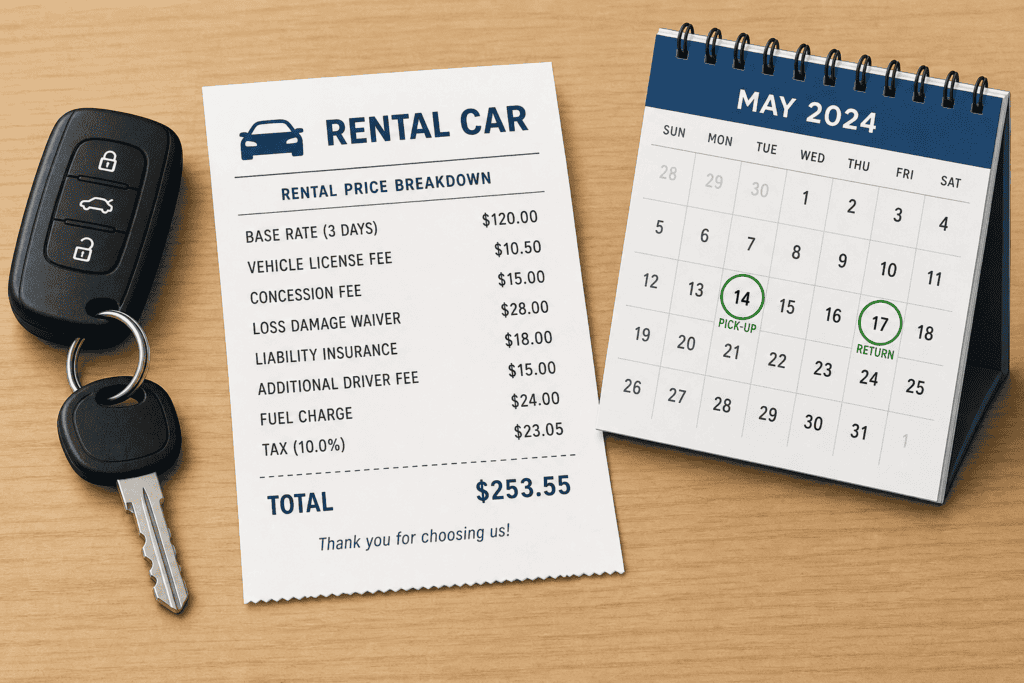
The daily rate shown in search results is rarely the full picture. A realistic total often includes:
- Base rental rate
- Taxes required by the local jurisdiction
- Airport or location access charges, when applicable
- One-way fees, if pickup and return locations differ
- Additional driver charges, if relevant
- Fuel policy considerations
- Any optional coverage or add-ons selected during booking
Two quotes with the same base daily rate can result in different final totals once these additional charges are applied. Reviewing the full cost breakdown before booking, rather than focusing only on the headline price, gives a more accurate comparison.
Hypothetical Example
Imagine a traveler compares two listings for the same compact car, same location, and same five-day rental period. Listing A shows a lower daily rate but includes a mandatory airport concession fee and a higher tax rate. Listing B shows a slightly higher daily rate but is picked up from a location with fewer added fees. Once totals are calculated, Listing B turns out to be the lower overall cost. This is illustrative only, but it demonstrates why comparing final totals matters more than comparing daily rates alone.
Why the Same Search Can Show a Different Price Later
Because rental pricing responds to live inventory and demand, a search performed today and the identical search performed a week later can return different numbers. This can happen in either direction — rates may increase as a date approaches and inventory tightens, or they may ease if demand for that date turns out to be lower than expected. Neither outcome is guaranteed, and the direction of change can vary by location, vehicle category, and how far away the pickup date is.
Because of this variability, it’s worth periodically rechecking a reservation if your plans and booking terms allow it, rather than assuming the first price you see is fixed.
Rental Pricing Factors at a Glance
| Factor | How It Can Influence Price |
|---|---|
| Vehicle category | Smaller fleets for vans, large SUVs, or specialty vehicles can tighten faster, affecting price and availability. |
| Pickup location | Airport counters may carry added fees; off-airport locations can have different inventory and demand. |
| Local events or seasonality | High-demand periods in a specific destination can push rates up for those dates. |
| Remaining fleet inventory | As available vehicles in a category decrease, remaining units can become more expensive. |
| Booking terms | Prepaid, pay-later, and third-party rates can carry different pricing and cancellation flexibility. |
This table illustrates general tendencies rather than fixed rules. Actual pricing still depends on your specific market and travel dates.
Common Pricing Myths Worth Questioning
Rental pricing attracts a lot of oversimplified advice. A few claims are worth treating with caution:
- “Prices always rise the closer you get to pickup.” Rates often trend that way when demand is strong, but they can also hold steady or occasionally ease depending on remaining inventory.
- “One specific day or time always produces the cheapest rate.” Pricing responds to live conditions rather than a fixed weekly or daily pattern.
- “The cheapest listed price is automatically the best deal.” A lower daily rate can still result in a higher total once fees, taxes, and location charges are included.
Treating rental pricing as dynamic — rather than governed by hidden shortcuts — leads to more reliable comparisons.
Before You Book
- Compare the same vehicle category across listings, not just similar-sounding names.
- Check whether the pickup location is an airport counter or an off-airport branch.
- Review the full price breakdown, including taxes and mandatory fees.
- Note whether the rate is prepaid or pay-later, and check the cancellation terms.
- Consider whether your travel dates overlap a local event, holiday, or peak season.
- Save your reservation details so you can compare accurately if you recheck pricing later.
- Confirm one-way fees apply if your pickup and return locations differ.
Frequently Asked Questions
Why did the price change when I searched again?
Rental pricing is typically dynamic, meaning it adjusts based on current demand and remaining inventory for your dates and vehicle category. A change between searches doesn’t necessarily mean anything went wrong; it reflects updated conditions at that location.
Is the cheapest listed price always the best deal?
Not necessarily. A lower base rate can still result in a higher total once taxes, location charges, or one-way fees are added. Comparing full totals for matching rental terms gives a more accurate picture.
Do all rental locations price the same way?
No. Airport counters, downtown branches, and suburban locations can have different fee structures and different demand patterns, even within the same city.
Does vehicle type affect how pricing behaves?
Yes. Categories with smaller fleets, such as minivans or large SUVs, can see price and availability shift more noticeably than high-volume categories like compact or midsize cars.
Can rental prices decrease after I book?
It’s possible, since pricing continues to respond to demand and inventory after your search. Whether this happens for your specific dates and location can vary, and any change should be compared carefully against your existing reservation’s terms before making adjustments.
Making Sense of Your Next Rental Quote
Car rental pricing isn’t random, but it also isn’t fixed. It moves in response to demand, vehicle availability, location, and booking terms, which is why identical searches can return different numbers on different days. Rather than looking for a shortcut that guarantees the lowest price, focus on comparing full totals for matching vehicle categories, locations, and dates. That approach gives you a clearer, more reliable way to judge whether a quote is reasonable for your trip.
Ready to Compare Airfares?
Compare current prices and availability before you book—fares can change quickly.
Search Flight Deals →