

Car Rental Savings Tips: The Complete Guide to Saving Money on Rental Cars
Saving money on a rental car is about much more than spotting the lowest daily rate on a search results page. The advertised price is only one piece of the puzzle. Pickup location, taxes, airport fees, insurance choices, vehicle class, rental length, cancellation policies, fuel rules, mileage limits, and add-ons can all change what you actually pay at the counter.
This complete guide walks you through every step of the rental process, from planning and comparing prices to picking up the keys. Along the way, you will learn how to avoid hidden fees, decide whether to prepay, evaluate insurance options, use coupons properly, and choose a vehicle that actually fits your trip. The goal is simple: help you compare smarter and stop overpaying for rental cars.
Keep in mind that rental car prices can shift based on destination, travel dates, vehicle availability, demand, fees, taxes, and the booking platform you use. Nothing in this guide is a guaranteed price, but the strategies below can help you make stronger decisions every time you rent.
Why Rental Car Prices Can Be Confusing
Rental car pricing rarely behaves like a fixed retail price. The same car at the same location can show very different rates depending on when you search, how long you rent, and where you pick up.
A few reasons rental car prices vary:
- Location demand: Airports, tourist cities, and major events drive prices up.
- Travel dates: Weekends, holidays, and peak seasons see higher rates.
- Vehicle availability: Limited inventory in a class can spike prices.
- Rental length: Daily, weekly, and monthly rates can be priced very differently.
- Vehicle class: Economy, SUV, luxury, and minivans each follow their own pricing curve.
- Taxes and fees: Airport concession fees, local taxes, and surcharges add up quickly.
- Add-ons: Insurance, toll passes, GPS, and child seats can change the total dramatically.
The advertised daily rate is rarely your final cost. To save real money, you need to compare the full out-the-door total.
Start With the Total Rental Cost, Not Just the Daily Rate
A $25 per day rental can easily turn into $55 per day after taxes and fees. That is why your comparison should always focus on the total price.
When evaluating any rental quote, look at:
- Base rate for the vehicle class
- Taxes for the city, state, or country
- Airport fees and concession recovery charges
- Insurance add-ons offered during booking
- Fuel charges if you do not return the car full
- One-way fees if pickup and return locations differ
- Young driver fees for renters under 25
- Extra driver fees for adding a second driver
- Mileage rules and per-mile charges if you exceed limits
- Toll programs and how they are billed
- Late return charges for going past your scheduled time
Once you see the full picture, the cheapest daily rate often is not the cheapest rental.
How to Find Cheap Car Rentals Without Overpaying
Finding a low rental price does not mean settling for a vehicle that does not fit your trip. The smarter approach is to compare options and trim costs you do not need.
Practical ways to keep prices down:
- Compare several booking sources rather than the first site you visit.
- Check different vehicle classes — sometimes a compact costs more than an economy because of inventory.
- Adjust pickup and return times by a few hours to see if rates change.
- Compare nearby locations within the same city.
- Decline add-ons that you do not need or already have coverage for.
- Always review the total price before checkout, not just the headline rate.
For a deeper walkthrough, see our guide on how to find cheap car rentals without overpaying.
Compare Car Rental Prices Before You Book
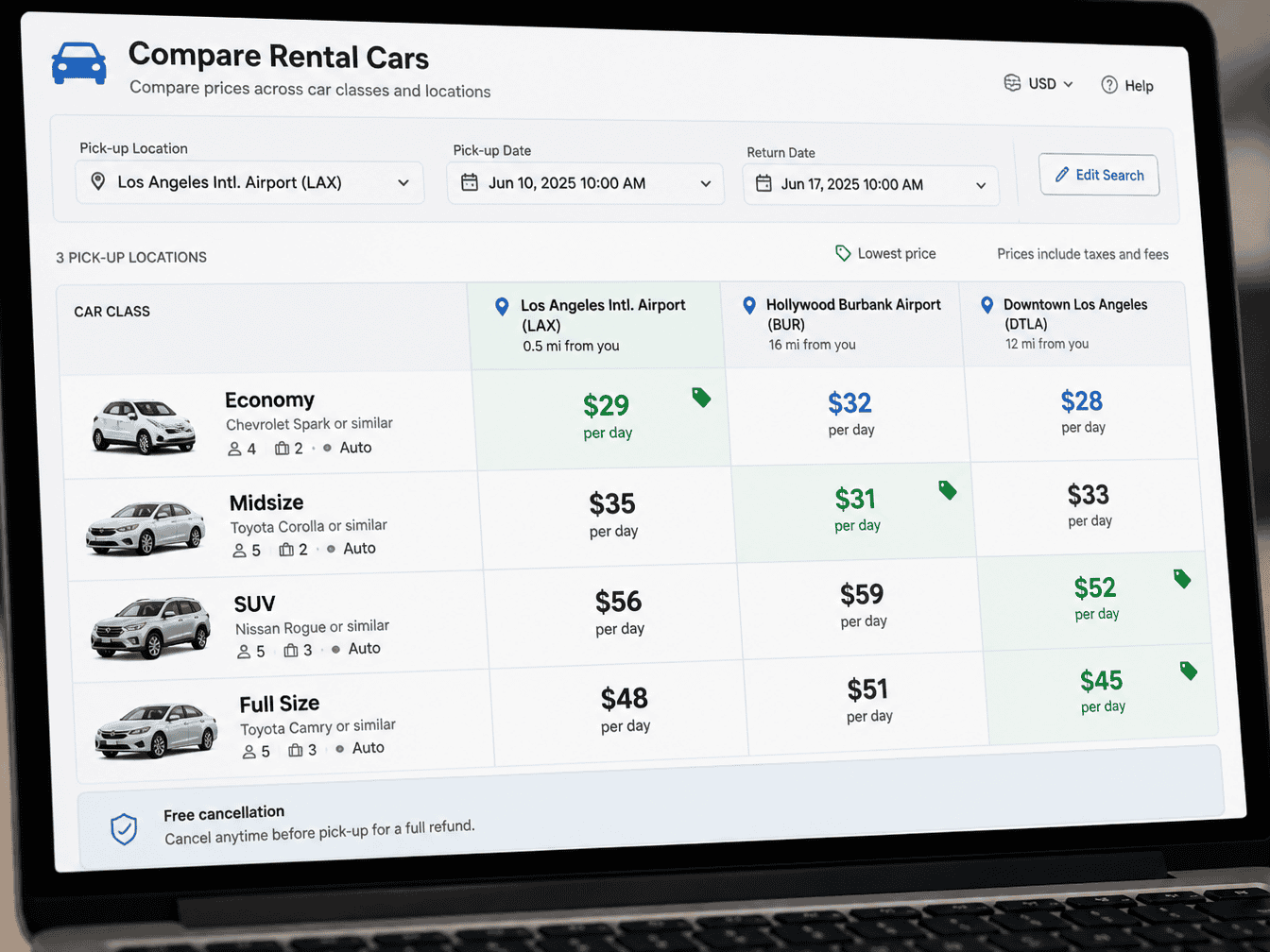
Comparison shopping is one of the simplest ways to save on a rental car, but only if you are comparing the right things.
To make a fair comparison:
- Use the same pickup and return dates across every search.
- Compare the same vehicle class between sites.
- Check both airport and nearby off-airport locations.
- Compare direct rental company prices with travel booking sites.
- Review the cancellation rules for each option.
- Always compare the total price after taxes and fees, not the base rate.
A small difference in pickup time or location can lead to a noticeably different total. Our guide on how to compare car rental prices goes into detail on each step.
Use the Right Car Rental Booking Sites
No single booking site is always the cheapest. Different platforms negotiate different rates, run different promotions, and show different inventory.
Sources worth checking:
- Rental company websites for direct rates and loyalty perks
- Travel booking sites that aggregate multiple companies
- Metasearch tools that scan multiple platforms at once
- Membership discounts through groups like AAA, AARP, Costco, or military
- Mobile-only rates that sometimes appear in rental apps
- Package deals when bundling with flights or hotels
- Loyalty program rates for frequent renters
To compare your options, see our breakdown of the best car rental booking sites compared.
How to Get the Best Deal on a Rental Car
Getting a good deal is rarely about one secret trick. It comes from layering a few smart habits across every booking.
A reliable approach:
- Book early for busy dates or peak seasons.
- Compare more than one source every time.
- Check nearby pickup locations to dodge airport surcharges.
- Avoid oversized vehicles if you do not need the space.
- Review mileage and fuel rules before booking.
- Skip unnecessary add-ons like prepaid fuel or premium toll passes if you do not need them.
- Use coupons when they apply legitimately.
- Recheck rates before travel if your booking has free cancellation — prices often drop closer to the date.
For more tips, see our guide on how to get the best rental car deal.
Airport vs Off-Airport Car Rentals

Where you pick up your rental can affect the price as much as which company you choose. Airport rentals are convenient but often carry extra fees. Off-airport locations can be cheaper, but they are not always practical.
What to weigh:
- Convenience of picking up on-site after a flight
- Airport concession recovery fees that increase the total
- Shuttle time if the rental counter is offsite at the airport
- Off-airport savings that may be 10–30% lower in some markets
- Transportation costs like rideshare to reach an off-airport counter
- Return convenience when racing to catch a flight
- Early or late flight timing if the off-airport location is closed
Our breakdown of airport vs off-airport car rentals can help you decide which fits your trip.
How to Save Money on Airport Car Rentals
If picking up at the airport is the right choice for your trip, you can still keep costs reasonable with a few habits.
Tips that help:
- Compare every rental company at that airport, not just the big names.
- Look at the all-in price, including airport-specific fees.
- Decline add-ons unless you have confirmed you need them.
- Choose a vehicle class that matches your trip, not the largest available.
- Book early during peak travel seasons or major events.
- Check weekly rates if you are renting for five or more days, since they sometimes beat daily rates.
- Know the pickup process so you do not get upsold at the counter.
For more strategies, see our guide on how to save money on airport car rentals.
Watch for Hidden Car Rental Fees
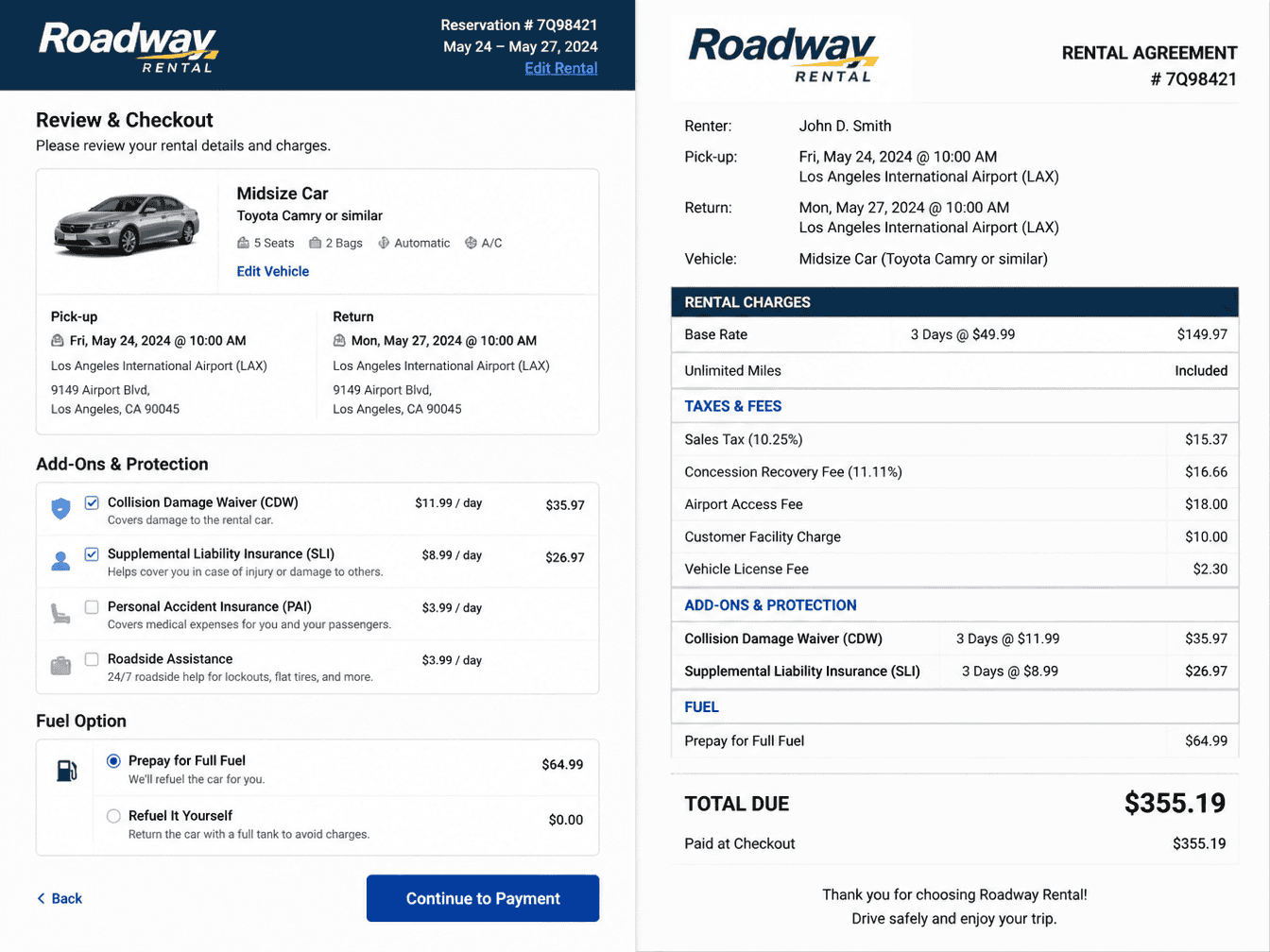
Hidden fees are one of the biggest reasons rentals end up costing more than expected. Many of these are not truly hidden — they are just easy to miss.
Common fees to watch for:
- Airport fees and concession recovery charges
- Extra driver fees for additional authorized drivers
- Young driver fees for renters under 25
- Fuel service charges if the tank is not returned full
- Toll pass charges that may be daily or per-use
- Late return fees for being even a short time over
- Mileage limits on certain rentals
- One-way fees for returning to a different location
- Insurance add-ons added at the counter
- Cleaning or smoking fees for excessive mess or smoke odor
- Child seat or GPS fees that add up quickly
Reading your rental agreement before signing can save you a lot. Our guide on how to avoid hidden car rental fees explains each one in detail.
Car Rental Insurance Explained
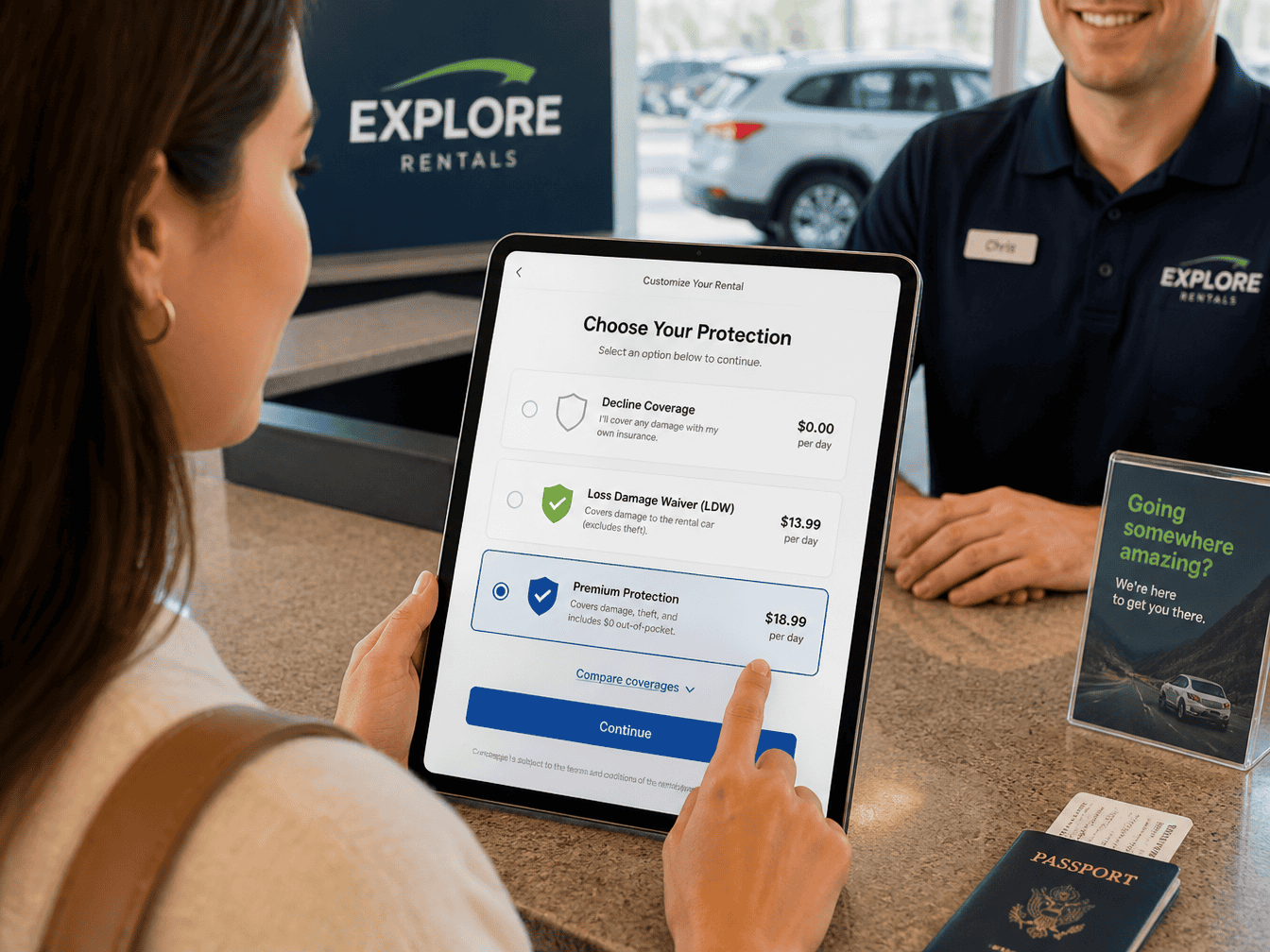
Rental car insurance can feel confusing, especially at the counter when you are tired and being asked to decide quickly. Understanding the basics ahead of time helps you avoid both being underinsured and paying for coverage you already have.
Common coverage types:
- Collision damage waiver (CDW) / Loss damage waiver (LDW): Reduces or removes your responsibility if the rental is damaged or stolen.
- Liability coverage: Helps cover damage or injury you cause to others.
- Personal accident insurance: Covers medical costs for you and your passengers.
- Personal effects coverage: Covers belongings stolen from the car.
- Credit card rental coverage: Many cards offer secondary or primary coverage when you pay with that card.
- Personal auto policy: Your existing auto insurance may extend to rentals.
- Travel insurance: Some travel policies include rental car protection.
Before declining or buying coverage, check what your auto policy and credit card already provide. Our guide on how rental car insurance works breaks each option down.
Should You Buy Rental Car Insurance?
There is no one-size-fits-all answer. Whether you should buy rental insurance depends on:
- Your existing auto insurance coverage
- Your credit card benefits when paying for the rental
- Your destination (some countries require additional coverage)
- The type of rental (luxury, SUV, or specialty vehicles may have limits)
- Your risk tolerance and comfort with potential out-of-pocket costs
- The rental company’s rules and any local minimums
Always confirm coverage with your insurer or card issuer before your trip. The convenience of declining coverage at the counter is not worth the risk if you are unsure of the details. For help thinking it through, see our guide on whether to buy rental car insurance.
Should You Prepay for a Rental Car?
Many rental companies offer two booking options: prepay now for a slightly lower rate, or pay at pickup with more flexibility.
Possible benefits of prepaying:
- Often a lower base rate
- Locks in pricing for your trip
- Some peace of mind for trip planning
Drawbacks of prepaying:
- Stricter cancellation rules
- Potential cancellation or change fees
- Less flexibility if your plans change
- Refund limitations if you cancel late
Pay-later may be smarter if your travel dates could shift, your vehicle class might change, or you want the freedom to rebook if rates drop. Our guide on prepaying for a rental car helps you compare both options.
How to Use Car Rental Coupons and Promo Codes

Coupons and promo codes can lower your rental cost — but only if they are valid and apply to your specific booking.
Where real discounts come from:
- Rental company promo codes posted on their official sites
- Membership discounts like AAA, AARP, Costco, or USAA
- Loyalty program rates for frequent renters
- Credit card travel offers through your card’s portal
- Airline or hotel partner discounts when you book with miles or points
- Coupon rules and exclusions that may limit blackout dates or vehicle classes
- Final price check to confirm the discount actually applied
Avoid random coupon sites with expired or fake codes. Our walkthrough of car rental coupons and promo codes shows how to use them without wasting time.
How to Save on Long-Term Car Rentals
Renting for a week, month, or longer? The pricing rules change, and the best strategies do too.
Things to consider:
- Weekly rates can be cheaper than 7 individual days at the daily rate.
- Monthly rates sometimes beat 4 weekly rentals stitched together.
- Mileage limits become much more important on longer rentals.
- Insurance costs can add up significantly over weeks or months.
- Maintenance rules for very long rentals — some companies require swaps.
- Pickup location can matter more for monthly bookings (off-airport often wins).
- Compare alternatives like rideshare costs or short-term car subscriptions when relevant.
Our guide on long-term car rental savings explains how to choose the best structure for extended trips.
How to Avoid One-Way Rental Fees
One-way rentals — where you return the car to a different location than where you picked it up — often come with extra fees. Sometimes these fees are small, but in some markets they can rival the rental cost itself.
Why one-way fees happen and how to handle them:
- Different pickup and return cities trigger drop fees.
- Airport-to-airport rentals can be especially expensive.
- City-to-city rentals vary widely by route.
- High-demand relocation routes sometimes have low or no fees because the company needs cars repositioned.
- Compare round-trip vs one-way pricing — round-trip can sometimes be cheaper even with extra transportation.
- Check nearby return locations for lower drop-off fees.
- Watch for limited-time one-way deals during slow seasons.
Our guide on how to avoid one-way rental fees covers each strategy in more detail.
Choose the Right Vehicle Class for Your Trip
The cheapest vehicle is not always the best value. Picking the wrong class can lead to extra fuel costs, cramped trips, or paying for upgrades at the counter.
Common rental classes:
- Economy: Smallest and usually cheapest, great for solo travel and short trips.
- Compact: Slightly more space, still fuel efficient.
- Midsize: A solid balance of price, comfort, and luggage room.
- Full-size: More space for passengers and bags, often only slightly more.
- SUV: Better for families, weather, or rough roads.
- Minivan: Best for groups, road trips, or lots of luggage.
- Luxury: Premium features at a premium price.
- Pickup truck: Useful for hauling, but pricier and less fuel efficient.
- Electric or hybrid vehicles: Can save on fuel but require charging planning.
Match the car to the trip — passengers, luggage, weather, distance — not just the lowest price.
Rental Car Savings Checklist Before You Book

Use this checklist before locking in your rental:
- Compare multiple booking sources.
- Check the rental company’s direct price.
- Compare airport and off-airport pickup locations.
- Review the total price after taxes and fees.
- Check insurance options before pickup.
- Decide whether prepaid or pay-later is better.
- Look for coupons or membership discounts.
- Compare vehicle classes to find the best fit.
- Review fuel and mileage rules.
- Check one-way rental fees if returning elsewhere.
- Recheck rates before travel if cancellation is flexible.
Working through this list helps you avoid the most common overpay traps and gives you a clear view of the real cost of your rental.
Related Car Rental Savings Guides
If you want to dig deeper into any topic from this guide, the resources below cover specific car rental savings strategies in more detail. Together they form a complete library for smarter, cheaper rentals.
- How to Find Cheap Car Rentals Without Overpaying
- How to Compare Car Rental Prices
- Best Car Rental Booking Sites Compared
- How to Avoid Hidden Car Rental Fees
- Car Rental Insurance Explained
- Should You Buy Rental Car Insurance
- How to Save Money on Airport Car Rentals
- Airport vs Off-Airport Car Rentals
- How to Get the Best Deal on a Rental Car
- How to Use Car Rental Coupons and Promo Codes
- How to Save on Long-Term Car Rentals
- How to Avoid One-Way Rental Fees
- Should You Prepay for a Rental Car
Final Thoughts on Saving Money on Rental Cars
The best rental car deal is rarely the lowest daily rate. Real savings come from comparing the total price, choosing the right pickup location, evaluating insurance carefully, watching for hidden fees, using valid discounts, and picking a vehicle class that actually fits your trip.
Take a few extra minutes during the booking process. Compare multiple sources, read the fine print on cancellations and fuel, and reassess your insurance before saying yes or no at the counter. Each small habit adds up to a smoother, less expensive rental experience.
Rental prices will keep changing based on destination, dates, demand, and policies — but the strategies in this guide can help you stay one step ahead every time you rent.
Frequently Asked Questions
What is the best way to save money on a rental car?
Compare the total price across multiple booking sources, check both airport and off-airport locations, decline add-ons you do not need, and choose a vehicle class that fits your trip. Also confirm whether your existing auto insurance or credit card already covers rental cars before paying for extra coverage.
Is it cheaper to rent a car at the airport or off airport?
It depends on the city. Off-airport locations are often cheaper because they avoid airport concession fees, but you may need to pay for a rideshare or transit to reach them. Always compare the total cost, including transportation to the pickup location.
Should I prepay for a rental car?
Prepaying can offer a lower base rate but usually comes with stricter cancellation rules. Pay-later is more flexible if your plans might change. Compare the savings against the cancellation policy before deciding.
How can I avoid hidden car rental fees?
Read the rental agreement carefully, decline add-ons you do not need, return the car on time and with the correct fuel level, avoid extra drivers when possible, and watch for airport, toll, and young driver fees that can quietly inflate the total.
Should I buy rental car insurance?
That depends on your existing auto policy, credit card benefits, destination, and risk tolerance. Always confirm what you already have before declining or buying coverage at the counter. Some destinations also have rules requiring specific coverage levels.
What is the cheapest car rental type?
Economy and compact cars are typically the cheapest. However, due to inventory, sometimes a slightly larger class is priced lower. Always compare a few classes to spot pricing quirks.
Do car rental prices change after booking?
Yes. Rental rates can rise or fall after you book. If your reservation has free cancellation, it can be worth checking again closer to your trip. If the rate drops, you may be able to rebook at the lower price.
Are car rental coupons worth using?
Legitimate coupons from rental companies, membership programs, or credit card portals can lower your rate. Random coupon code sites are often unreliable. Always confirm the discount applied to the final total before completing the booking.
How can I save on a long-term rental car?
Look for weekly or monthly rates instead of daily rates, compare off-airport pickup locations, review mileage limits carefully, and consider how insurance costs add up over a longer rental. For very long needs, compare rental options to short-term car subscriptions or rideshare costs.
How do I avoid one-way rental car fees?
Compare round-trip pricing first, check nearby return locations for lower drop fees, watch for promotional one-way routes where companies need cars relocated, and confirm any drop fees in writing before booking.Add to Conversation