

Car Rental Pricing Explained: The Complete Guide to How Rental Car Rates Work
If you have ever booked a rental car, you may have noticed something strange: the same vehicle class can cost very different amounts depending on the date, the pickup location, the booking site, or even the time of day you search. One day a compact car looks affordable, and the next day the price has jumped, dropped, or changed entirely.
That is because rental car pricing is not a fixed sticker price. It is a moving number shaped by demand, fleet availability, location, taxes, fees, insurance choices, and the platform you book through.
This guide breaks down rental car pricing in simple, practical terms so you can understand what you are actually paying for, why prices shift, and how to spot the real cost before you click “book.” Keep in mind that rental rates can vary widely by destination, dates, vehicle class, and many other factors, so the goal here is understanding — not guarantees.
Why Car Rental Pricing Can Be Confusing
Unlike a product on a store shelf, rental car rates are not fixed. The price you see today may not be the price you see tomorrow, even for the same vehicle class at the same location.
Here is why pricing feels confusing:
- Rates change based on demand and fleet availability.
- Pickup location can raise or lower the daily rate.
- Rental length can change which rate plan applies.
- Vehicle class availability shifts throughout the day.
- Local events, holidays, and weekends can spike rates.
- Airport pickups often include extra fees.
- Taxes and add-ons can vary by city and state.
- Insurance choices can significantly change the total.
The advertised daily rate is only one piece of the puzzle. The final price often includes taxes, airport charges, fees, and optional add-ons that can change the total dramatically.
Why Car Rental Prices Change Frequently

Rental rates are not random. They move because the rental market is constantly responding to real-world conditions. Understanding why car rental prices change frequently can help you avoid being surprised when a quote shifts from one search to the next.
Common reasons rental car prices change:
- Vehicle availability — fewer cars available often means higher rates.
- Local demand — heavy demand in a city can push prices up.
- Airport demand — busy airports can have higher base rates.
- Travel season — peak seasons typically cost more.
- Holidays and weekends — short-term spikes are common.
- Local events — concerts, conventions, and sports events can raise prices.
- Rental length — daily, weekly, and monthly rates may differ.
- One-way rental demand — some routes carry repositioning costs.
- Vehicle class availability — SUVs and minivans often sell out faster.
- Competitor pricing — companies adjust rates to stay competitive.
- Booking platform differences — different sites can show different prices.
Because so many things shape pricing, it is normal to see rates change throughout the day or week.
What Affects Car Rental Prices the Most
Some factors influence pricing more than others. If you understand the biggest factors that affect rental car prices, you can make smarter booking decisions.
Top factors that affect rental car pricing:
- Pickup and return location — airport, downtown, or off-airport.
- Travel dates — peak vs. off-peak.
- Vehicle class — economy, compact, SUV, minivan, luxury.
- Rental length — short trips vs. weekly rentals.
- Airport vs. off-airport pickup — airport rentals often include extra fees.
- Taxes and fees — vary by city, state, and airport.
- Insurance and add-ons — can substantially raise the total.
- Fuel rules — prepaid, refill, or service fee policies.
- Mileage rules — unlimited vs. capped mileage.
- One-way returns — usually adds a fee.
- Driver age — younger drivers may pay surcharges.
- Local demand and fleet supply — both can shift prices daily.
No single factor decides the price. The combination matters most.
How Car Rental Pricing Works Behind the Scenes

Rental car pricing may feel mysterious, but it follows patterns. Understanding how car rental pricing works behind the scenes helps explain why the same car can cost $40 one day and $90 the next.
Here is what is happening behind the scenes:
- Rental companies adjust rates based on expected demand. When more people are searching, prices may climb.
- Limited vehicle inventory affects rates. A small fleet at a specific location can mean higher prices.
- Some vehicle classes sell out faster. SUVs, minivans, and large vehicles often go first.
- Airport and destination demand can raise prices. Tourist hotspots often cost more.
- Companies may adjust rates as the pickup date approaches. Prices can rise or fall closer to your trip.
- Longer rentals may qualify for different rate structures. Weekly rates often differ from daily totals.
- Flexible and prepaid rates may not cost the same. Prepaid rates may be lower but harder to cancel.
In short, rental rates are dynamic — they react to supply, demand, and timing.
Why the Same Rental Car Can Have Different Prices
You might search for a midsize sedan at one airport and see three different prices across three different sites. That is normal. Pricing differences exist because each booking channel has its own deals, contracts, and rules.
Common reasons for price differences:
- Rental company website vs. booking site — direct sites and third-party sites may differ.
- Membership rates — AAA, Costco, AARP, and others may unlock special rates.
- Loyalty rates — frequent renters may see member-only pricing.
- Mobile app rates — some apps offer different prices than desktop.
- Prepaid vs. pay-later rates — prepay typically saves more but limits flexibility.
- Coupon codes — promo codes can lower the displayed rate.
- Airport vs. nearby pickup locations — even a few miles can change the price.
- Different cancellation rules — flexible rates often cost more.
- Taxes and fees displayed differently — some sites hide fees until checkout.
- Vehicle class availability — limited inventory affects pricing.
Always compare the total price, not just the headline rate.
How Location Affects Car Rental Prices

Where you pick up your car can matter as much as when. Learning how location affects car rental prices is one of the easiest ways to spot real savings — or hidden costs.
Common location types:
- Airport rental counters — convenient but typically include extra fees.
- Off-airport rental branches — often cheaper but may require a shuttle, taxi, or rideshare.
- Downtown pickup locations — popular for city trips but can have limited inventory.
- Neighborhood branches — often quieter, with shorter hours.
- Tourist destination locations — pricing reflects high seasonal demand.
- Limited-inventory locations — small fleets can mean higher prices.
- Remote or seasonal markets — beach towns or ski areas may swing widely by season.
- Return location differences — returning at a different spot may add fees.
A cheaper off-airport rental is not always the better deal. If you have to pay for a rideshare to reach the location, wait for shuttle service, or work around limited office hours, the savings may shrink quickly.
Airport Car Rental Fees Explained

Airport pickups are convenient, but they often come with fees you will not see at off-airport branches. Here is a breakdown of common airport car rental fees explained on a typical booking.
Fees you may see on an airport rental:
- Airport concession recovery fees — paid by the rental company to operate at the airport, then passed to you.
- Facility charges — for upkeep of the rental car center.
- Tourism or transportation-related charges — vary by city and state.
- Convenience pricing — airport rentals are easy and fast, which is reflected in the price.
- Shuttle and rental car center costs — built into the airport rental structure.
Are airport rentals worth it? Sometimes yes — especially for short trips, late arrivals, or when transportation to an off-airport branch would cost just as much. Always compare the full airport price with nearby off-airport options before deciding.
Car Rental Taxes and Extra Charges Explained
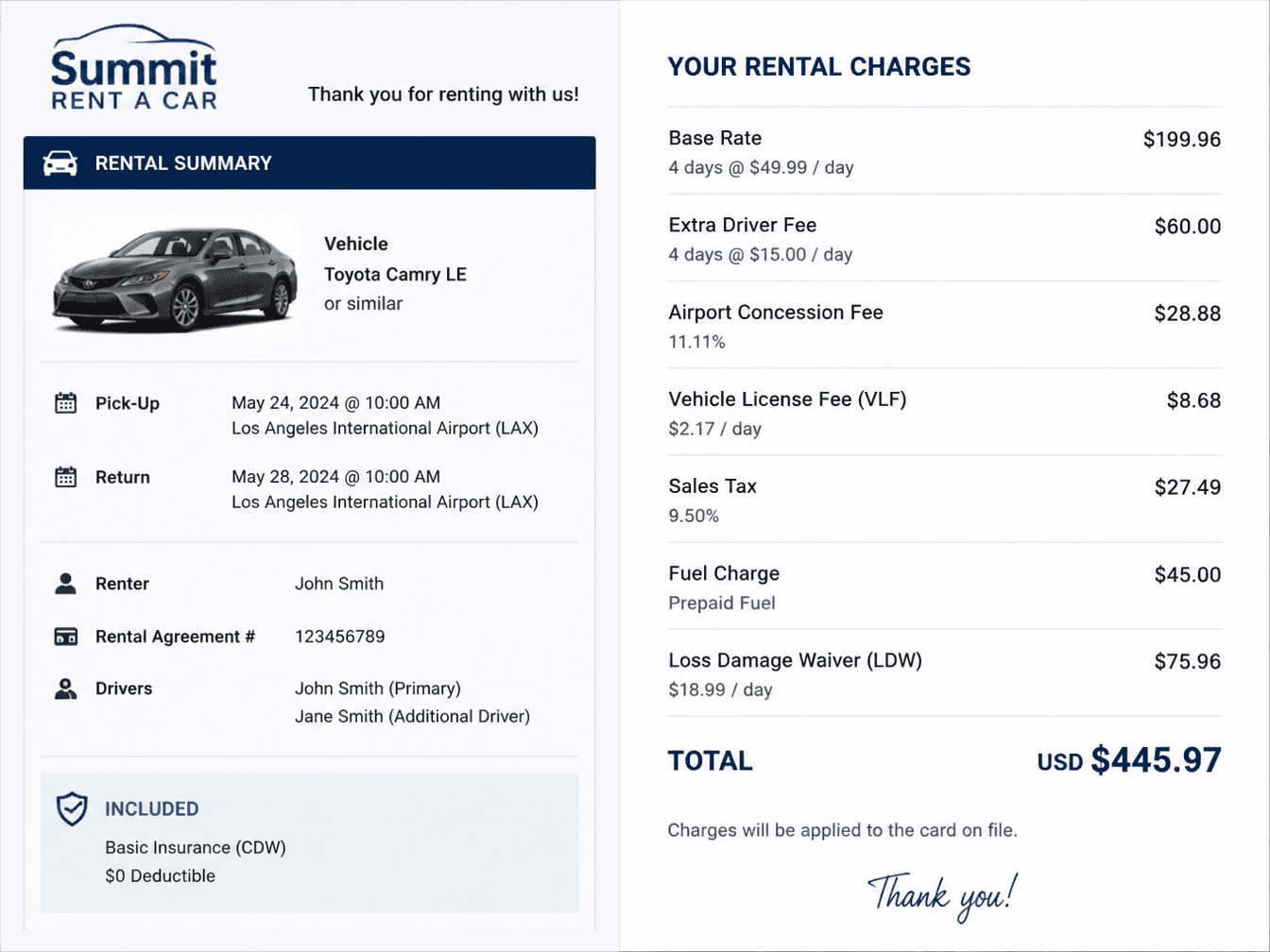
Many travelers focus on the daily rate and forget that taxes and extra charges can dramatically increase the total. Reviewing the full breakdown of car rental taxes and extra charges explained helps you avoid surprises at checkout.
Common taxes and extra charges:
- State and local taxes
- Airport fees and concession recovery
- Facility charges
- Extra driver fees
- Young driver fees (typically for drivers under 25)
- Fuel service charges if you do not refill
- Toll pass charges
- Late return fees
- Mileage charges on capped-mileage rentals
- Cleaning or smoking fees
- Add-ons like child seats, GPS, and ski racks
The base rate is the starting point. The total is what really matters.
One-Way Car Rental Fees Explained
Need to pick up a car in one city and drop it off in another? That convenience usually has a cost. Understanding one-way car rental fees explained can help you compare options before booking.
Why one-way rentals can cost more:
- Different pickup and return locations add operational costs.
- Vehicle repositioning — companies must move cars back to high-demand cities.
- Limited one-way inventory — not all locations allow it.
- Airport-to-airport rentals can have steeper fees.
- City-to-city rentals depend on route popularity.
- High-demand routes may cost more during peak seasons.
Tips to compare:
- Check round-trip vs. one-way pricing if your plans are flexible.
- Try alternate return locations — even a nearby branch can change the fee.
- Compare different rental companies, since one-way pricing varies.
Rental Car Insurance Costs Explained
Insurance is one of the biggest swing factors in your final price. Adding full coverage can sometimes double the rental cost, which is why understanding rental car insurance costs explained is so important before pickup.
Common rental insurance options:
- Collision Damage Waiver (CDW) — covers damage to the rental.
- Liability coverage — covers damage to other vehicles or property.
- Personal Accident Insurance — covers medical costs for you and passengers.
- Personal Effects Coverage — covers personal items in the car.
- Roadside assistance — helps with lockouts, flats, and breakdowns.
Before adding insurance, consider:
- Credit card coverage — many travel credit cards include some rental coverage.
- Personal auto insurance — may already extend to rentals.
- Travel insurance policies — some include rental car protection.
Always verify your existing coverage before the counter. Insurance add-ons can change the total price significantly, sometimes more than any other line item.
Do Car Rental Prices Drop Last Minute?

Sometimes — but not always. The question of whether rental car prices drop near pickup depends on local demand, fleet availability, and timing.
When last-minute drops may happen:
- A location has extra unrented vehicles.
- Demand was lower than expected.
- A specific vehicle class is overstocked.
- It is the off-season.
When prices may rise instead:
- High-demand holidays and events.
- Sold-out airports.
- Limited fleet availability.
- Peak summer or spring break travel.
Waiting for a last-minute deal can pay off for flexible solo travelers. But families, large groups, or travelers needing specific vehicles like minivans or full-size SUVs are usually better off booking early. Most rentals can be cancelled or rebooked if a lower rate appears later, so booking now and rechecking prices closer to your trip is often the safest strategy.
Cheapest Months to Rent a Car

Rental prices ebb and flow with the seasons. There is no universal “cheapest month,” but generally, off-peak periods bring lower rates. Looking at the cheapest months to rent a car by destination can help you plan smarter.
Patterns to consider:
- Off-peak travel periods — typically January, February, early December, and parts of fall.
- Shoulder seasons — late spring and early fall often have softer demand.
- Summer travel — generally pricier, especially in tourist cities.
- Spring break — March can spike in beach destinations.
- Winter holidays — late December is often peak.
- Local event seasons — festivals and major sports events lift prices.
- Weather-related travel patterns — ski markets surge in winter, beaches in summer.
The “cheapest month” depends heavily on the destination. Ski towns are cheapest in summer; beach towns are cheapest in winter. Always check pricing for your specific city, not just nationwide averages.
Why the Lowest Daily Rate Is Not Always the Best Rental Car Deal
A $19/day rental sounds amazing — until you reach the checkout page and see $480 in taxes, fees, and add-ons.
A truly good deal considers:
- Taxes and fees included in the total.
- Pickup location convenience.
- The right vehicle class for your trip.
- Mileage rules (unlimited vs. capped).
- Fuel policy clarity.
- Insurance add-ons.
- Cancellation flexibility.
- One-way fees if applicable.
- Airport fees if applicable.
- Pickup and return convenience.
A slightly higher daily rate with included perks and better policies often beats a “cheap” rate with hidden costs.
How to Compare the Real Cost of a Rental Car
Use this step-by-step checklist when comparing rentals:
- Compare the same pickup and return dates across all sites.
- Compare the same vehicle class.
- Check airport and off-airport locations.
- Review prepaid vs. pay-later terms.
- Look at taxes and fees in the final breakdown.
- Check airport and facility charges.
- Review insurance and add-ons.
- Compare mileage and fuel rules.
- Check one-way fees if returning elsewhere.
- Focus on full trip value, not just the base rate.
Apples-to-apples comparison is the only way to know which option is truly cheaper.
Car Rental Pricing Checklist Before You Book
Run through this list before confirming your rental:
- Are your dates during peak season?
- Are there holidays or local events that could spike prices?
- Is the pickup location at an airport?
- Is an off-airport location cheaper after transportation costs?
- Is the vehicle class right for your trip and luggage?
- Are taxes and fees included in the displayed price?
- Are insurance add-ons included or separate?
- Is there a one-way rental fee?
- Are fuel and mileage rules clear?
- Is the cheaper rate prepaid or nonrefundable?
- Is the final total — not just the daily rate — still a good deal?
If you can answer these confidently, you are likely getting a fair price.
Related Car Rental Pricing Guides
Want to dig deeper into specific parts of rental pricing? These supporting guides go further into the topics covered in this pillar article:
- Why Car Rental Prices Change Frequently
- What Affects Car Rental Prices Most
- How Car Rental Pricing Works Behind the Scenes
- How Location Affects Car Rental Prices
- Airport Car Rental Fees Explained
- Car Rental Taxes and Extra Charges Explained
- One-Way Car Rental Fees Explained
- Rental Car Insurance Costs Explained
- Do Car Rental Prices Drop Last Minute
- Cheapest Months to Rent a Car
Final Thoughts on Car Rental Pricing
Car rental pricing is shaped by far more than the vehicle itself. Demand, location, fleet supply, taxes, airport fees, one-way charges, insurance, and even the booking platform all influence the final price.
The smartest approach is to:
- Compare total cost rather than the daily rate.
- Understand how location and timing impact your price.
- Review taxes and fees before checkout.
- Choose insurance based on real coverage needs.
- Watch for airport and one-way charges.
- Stay flexible when possible — and rebook if rates drop.
Rental rates can vary by destination, dates, vehicle class, demand, and many other factors. No single tip guarantees the lowest price, but understanding how rental pricing works helps you make smarter, more confident booking decisions.
Frequently Asked Questions
Why do car rental prices change so often?
Rental car rates change because they respond to demand, fleet availability, location, season, holidays, and competitor pricing. As any of these shift, prices can move up or down — sometimes within the same day.
What affects car rental prices the most?
The biggest factors are pickup location, travel dates, vehicle class, rental length, airport fees, insurance choices, and local demand. Together, these usually have a bigger impact than the headline daily rate.
How does car rental pricing work?
Rental companies use dynamic pricing models that adjust based on demand, fleet supply, and how far away the pickup date is. Prices may rise when demand is high and may drop when extra inventory needs to move.
Why is the same rental car cheaper on one site?
Different sites have different deals, member rates, prepaid options, coupon codes, and cancellation rules. The same vehicle class may also have different inventory contracts on different platforms.
Does pickup location affect rental car prices?
Yes — significantly. Airport rentals usually include extra fees, while off-airport branches may be cheaper but less convenient. Even nearby branches can have different rates based on local demand.
Why are airport car rentals more expensive?
Airport rentals typically include concession recovery fees, facility charges, and tourism-related taxes. These cover the cost of operating at the airport and are passed on to renters.
What extra charges are added to rental cars?
Common extras include taxes, airport fees, extra driver fees, young driver fees, fuel charges, mileage charges, toll passes, late return fees, cleaning fees, and add-ons like GPS or child seats.
Why do one-way rental cars cost more?
Picking up and returning a car at different locations creates repositioning costs for the company. Limited one-way inventory and high-demand routes can also raise the price.
How much do rental car insurance options affect the price?
Insurance can be one of the largest factors in your total. Adding full coverage at the counter can substantially raise the rental cost, which is why many travelers check personal auto, credit card, or travel insurance coverage first.
Do car rental prices drop last minute?
Sometimes. If a location has extra cars and lower demand, prices may dip near the pickup date. But during peak times, prices often rise instead. Waiting for last-minute drops can pay off for flexible travelers but is risky for families or those needing specific vehicles.
What are the cheapest months to rent a car?
Off-peak months — often January, February, early December, and parts of fall — tend to be cheaper in many markets. However, the cheapest month varies by destination, since beach, ski, and tourism cities each have their own demand patterns.Add to Conversation