

Two rental car listings can show the same daily rate and still end up costing you very different amounts once you actually pick up the vehicle. The base price is only one part of the equation. To compare offers fairly, you need to line up the same dates, the same location, the same vehicle category, and the same policies before you even look at the price tag.
Quick Answer: To compare car rental prices correctly, match the pickup and return dates, times, and locations, confirm you’re looking at the same vehicle category and driver age requirements, then add taxes, mandatory location charges, and any one-way or additional-driver fees to each quote. Only after calculating each offer’s realistic total cost — not just the advertised daily rate — should you decide which rental is actually the better value.
Why Two Similar-Looking Quotes Aren’t Always Equal
Rental search results often display a low starting price that doesn’t reflect what you’ll actually pay at the counter or on your final receipt. Two quotes can differ in vehicle category, mileage allowance, fuel policy, or cancellation terms even when the daily rate looks nearly identical. If you compare only the number on the screen, you may end up choosing the rental that looks cheaper but costs more once everything is included.
This is different from simply searching for a low price. If you haven’t started your search yet, Car Rental Savings Scout covers the broader process of finding an affordable rental in the first place. This article focuses specifically on how to compare offers you’ve already found, side by side, so you’re evaluating equivalent rentals rather than apples to oranges.
The Checklist: What Must Match Before You Compare Price
Before comparing dollar amounts, confirm that both offers share the same underlying conditions. If any of these differ, the price difference may simply reflect a different rental, not a better deal.
- Pickup date and time — even a shift of a few hours can change pricing and availability.
- Return date and time — a longer or shorter rental window changes the total cost.
- Pickup location — airport counters, off-airport branches, and neighborhood locations can price differently.
- Return location — returning to a different location than pickup may introduce additional charges.
- Vehicle category — an economy car and a compact SUV are not the same comparison, even at a similar price.
- Driver age — rates and eligibility can vary for drivers under a certain age.
- Mileage allowance — unlimited mileage versus a capped allowance changes the real value of a lower rate.
- Fuel policy — a full-to-full policy differs from prepaid fuel options in total cost.
- Cancellation conditions — a slightly higher rate with free cancellation may be worth more than a locked-in low rate.
- Payment requirements — some rates require prepayment in full, while others allow pay-at-pickup.
Calculating the Realistic Total Cost of Each Offer
Once the conditions above are aligned, add up what each rental will actually cost. Start with the base rate, then layer on the charges that apply to your situation:
- Taxes
- Mandatory location or facility charges
- Airport-specific charges, if picking up at an airport counter
- Additional-driver charges, if more than one person will drive
- Young-driver charges, if applicable
- One-way or drop charges, if returning to a different location
- Estimated fuel cost based on the fuel policy
- Optional products you plan to add, priced separately from the base rate
Mandatory charges are not optional — they apply regardless of what you choose. Optional products, such as protection add-ons or equipment rentals, should be priced and compared separately so you can see how much of the total is truly fixed. For a deeper look at charges that often get overlooked during comparison, see rental costs beyond the base rate.
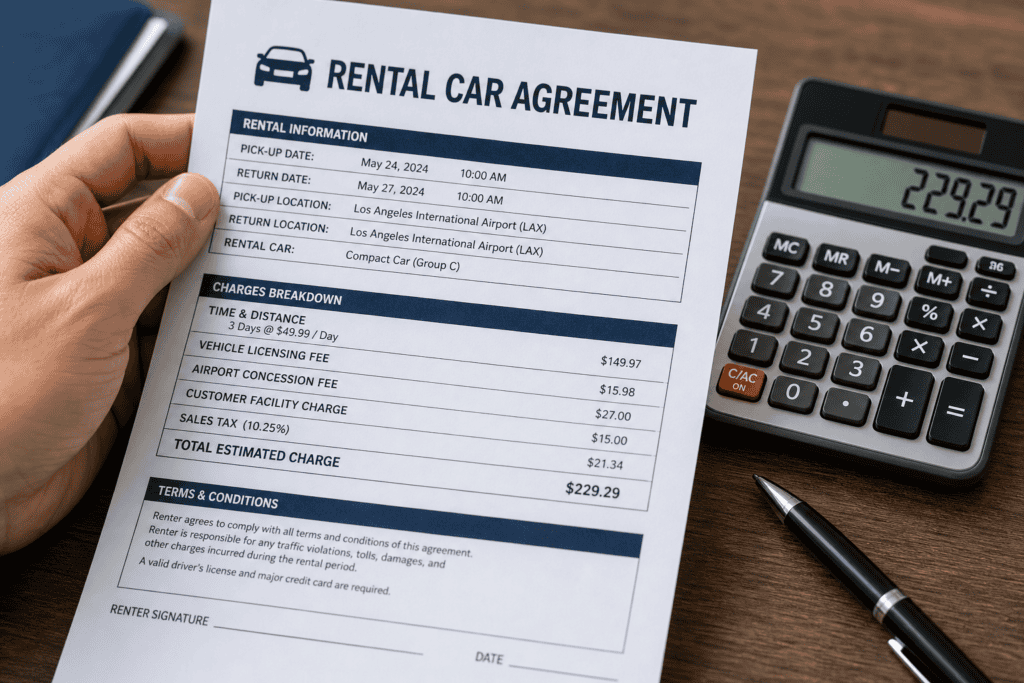
Using a Comparison Table to Line Up Offers
A simple side-by-side table can make the difference between two quotes much easier to see than scrolling between browser tabs.
| Factor | Rental A | Rental B | What to Check |
|---|---|---|---|
| Base rate | Lower | Higher | Starting price only, not the full picture |
| Location charges | Included in quote | Added at checkout | Confirm what’s mandatory versus optional |
| Mileage allowance | Limited | Unlimited | Estimate your expected driving distance |
| Cancellation policy | Non-refundable | Free cancellation | Weigh against trip certainty |
| Estimated total cost | Calculate fully | Calculate fully | Compare the complete rental, not the headline rate |
Fill in your own numbers for each quote you’re evaluating. The goal isn’t to find the lowest single line item — it’s to see which offer produces the lower realistic total once every relevant charge is included.
A Hypothetical Comparison Example
The following figures are illustrative only and do not reflect actual current rental pricing. They’re meant to show how the comparison process works.
Rental A
- Base rate: $180 for the rental period
- Taxes and location charges: $45
- Estimated fuel cost: $30
- Estimated total: $255
Rental B
- Base rate: $165 for the same rental period
- Taxes and location charges: $60
- Estimated fuel cost: $30
- Estimated total: $255
In this hypothetical, the two rentals arrive at the same total cost despite different starting rates. Without adding up the full picture, a traveler might have assumed Rental B was the better deal simply because its base rate looked lower. Your actual comparison should use the real figures shown in each quote for your specific dates and location.
Does Pickup Location Affect the Comparison?
Yes, pickup location can meaningfully change both the price and the fees attached to a rental. Airport counters often carry location-specific charges that a neighborhood branch may not include, while off-airport locations can have different hours and availability. If you’re comparing an airport quote against an off-airport quote for the same dates, make sure you’re also accounting for any transportation needed to reach the off-airport office. A closer look at how pickup location affects pricing is covered in the guide on airport car rentals.
This dynamic can look different depending on the market. In a destination like Orlando, where theme-park travel drives heavy airport demand, pickup location and vehicle size may carry more weight in the comparison. In a market like Phoenix, where drivers may cover longer distances between neighborhoods, mileage allowance can matter just as much as the base rate. Always compare quotes for your specific city rather than assuming pricing patterns carry over from one destination to another.
Should You Compare Across Rental Companies or Just Rates?
Both matter, but they answer different questions. Comparing rates for the same company across different dates or locations tells you when and where that company is offering a better price. Comparing across different companies tells you whether a competitor offers a stronger total value for the same rental conditions. If you’re still deciding which providers to include in your comparison, see the framework in comparing rental providers. No single company is consistently the lowest-priced option in every market, so running the comparison for your specific trip is the only reliable way to know.
It’s also worth checking whether the booking channel itself changes the comparison. A direct rate from the rental company’s own site and a rate from a comparison site can carry different cancellation terms or fine print even when the advertised price looks similar. For guidance on weighing those differences, see comparing car rental booking channels.

Common Mistakes When Comparing Rental Prices
- Comparing base rates without adding taxes and mandatory charges.
- Comparing two different vehicle categories as if they were the same rental.
- Ignoring mileage limits when planning a long-distance trip.
- Overlooking whether cancellation terms differ between quotes.
- Assuming a slightly higher advertised rate always means a worse deal.
- Forgetting to price optional products separately from the mandatory total.
- Comparing an airport quote to an off-airport quote without factoring in transportation.
Before You Book
- Confirm both quotes use the same pickup and return date and time.
- Confirm both quotes use the same pickup and return location.
- Verify you’re comparing the same vehicle category.
- Check the mileage allowance for each offer.
- Review the fuel policy attached to each quote.
- Add taxes and mandatory location charges to each base rate.
- Check cancellation and payment terms before locking in a lower rate.
- Price any optional products separately from the mandatory total.
Frequently Asked Questions
What is the fastest way to compare car rental prices?
Line up the pickup date, return date, location, and vehicle category first, then add taxes and mandatory charges to each quote before comparing totals. Comparing advertised base rates alone can be misleading.
Why do two rentals with the same base rate sometimes cost different totals?
Differences in location charges, mileage allowance, fuel policy, or one-way fees can change the final total even when the starting rate is identical. Always calculate the full estimated cost rather than relying on the headline price.
Is it better to compare rates from the same company or different companies?
Both are useful. Comparing the same company across dates or locations can reveal timing-based savings, while comparing different companies for the same conditions shows whether a competitor offers stronger overall value for your trip.
Does the vehicle category affect how I should compare prices?
Yes. A lower price on a smaller vehicle isn’t a fair comparison against a higher price on a larger category. Always compare rentals within the same vehicle class.
Should I compare cancellation policies along with price?
Yes. A rate with flexible cancellation may be worth more than a slightly lower rate that’s non-refundable, especially if your travel plans could change.
Comparing Total Rental Cost, Not Just the Headline Rate
The smartest way to compare car rental prices is to treat the advertised daily rate as a starting point, not the answer. Match the dates, location, vehicle category, and policies across each offer, then add taxes, mandatory charges, and any relevant one-way or fuel costs before deciding which rental actually costs less. Once you’re comfortable comparing individual quotes this way, you can apply the same approach across companies and booking channels. For the broader savings strategy this comparison method supports, revisit the Car Rental Savings Scout resources as you plan your next trip.
Ready to Compare Airfares?
Compare current prices and availability before you book—fares can change quickly.
Search Flight Deals →