
When you reach the counter or the checkout screen for a rental car, you’re often asked whether you’d like to add protection coverage. These optional products can add anywhere from a modest daily charge to a cost that rivals the rental itself, and the terminology can be confusing. Understanding what these products generally cover, how their pricing works, and what factors might already apply to your situation can help you make a more informed decision at booking time.
Quick Answer
Rental car insurance and protection products are optional add-ons priced separately from the base rental rate, and costs vary by rental company, location, vehicle category, and coverage type. These charges are not government taxes, and they’re rarely mandatory. Before purchasing, check whether your personal auto policy, credit card, or travel insurance already provides relevant coverage, since duplicate protection can add unnecessary cost.
What “Rental Car Insurance” Usually Refers To
The phrase “rental car insurance” is often used loosely to describe several different products. In practice, most rental companies offer a handful of optional protection categories, and the names and coverage details vary by company and by country. Broadly, travelers may encounter:
- Collision or damage waivers — These generally limit your financial responsibility for damage to the rental vehicle itself, though the specific terms, deductibles, and exclusions differ by provider.
- Liability-related products — These may supplement liability protection in situations involving damage or injury to other people or property.
- Personal accident coverage — This category typically relates to medical costs for the driver and passengers involved in an accident.
- Personal effects coverage — This addresses belongings inside the vehicle, such as luggage or electronics, in the event of theft or damage.
Because terminology and coverage details vary so widely between companies, and even between locations operated by the same company, it’s worth reading the specific terms offered at the time of booking rather than assuming one product means the same thing everywhere. These optional add-ons are one of several elements that make up the total cost of an airport car rental or any other pickup location.
[[IMAGE_1]]
Why Protection Product Pricing Varies
Unlike a fixed government tax, the price of an optional protection product is set by the rental company and can differ based on several factors, including:
- The rental company and the specific product being offered
- The rental location or country
- The vehicle category being rented
- The length of the rental period
- Whether the coverage is bundled with other products or sold individually
Because pricing isn’t standardized across the industry, the same type of coverage can cost noticeably different amounts depending on where and how you book. This is similar to how other charges on a rental agreement can vary — a topic covered in more general terms when looking at what affects rental prices overall.
How Protection Costs Fit Into Your Total Rental Price
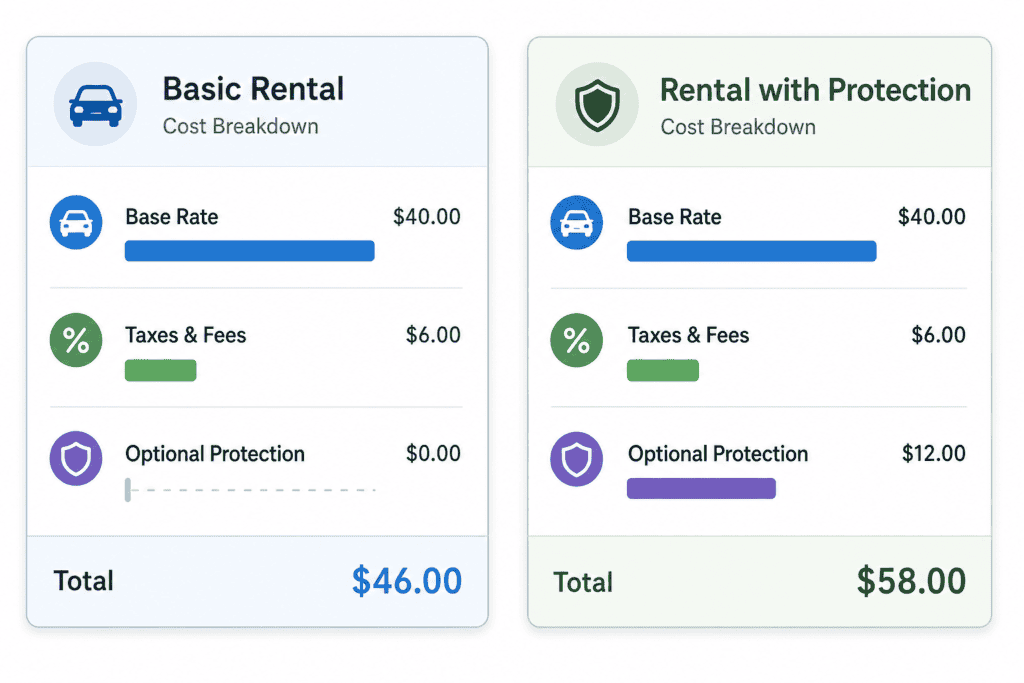
A common misunderstanding is treating the advertised base rate as the full cost of a rental. Optional protection products are added on top of the base rate, along with any applicable taxes and mandatory location charges. The base rate you see during a search is rarely the amount you’ll actually pay if you add coverage at the counter.
Here’s a simplified, hypothetical illustration of how this can play out:
| Line Item | Rental A (Illustrative) | Rental B (Illustrative) |
|---|---|---|
| Base rental rate | $210 | $225 |
| Estimated taxes and mandatory charges | $38 | $30 |
| Optional damage waiver (if added) | $70 | $45 |
| Estimated total with coverage added | $318 | $300 |
In this hypothetical example, Rental A has the lower base rate, but once an optional protection product is added, Rental B ends up costing less overall. Actual rates, product pricing, and terms will vary by company, location, and date, so treat this only as an illustration of why comparing base rates alone can be misleading.
Existing Coverage That May Already Apply
Before deciding whether to purchase a rental company’s protection product, it can help to check what coverage you may already have through other sources, such as:
- Your personal auto insurance policy, which may extend some coverage to a rental vehicle depending on your policy and location
- Certain credit cards, which may include rental car benefits when the card is used to pay for the reservation
- Travel insurance policies, which sometimes include rental-related provisions
Coverage details differ significantly from one policy or card to another, and exclusions are common. This article can’t tell you whether your specific policy or card applies to your specific rental, so it’s worth confirming directly with your insurer or card issuer before you rely on it instead of, or alongside, a rental company’s product.
Vehicle Category and Location Can Influence Cost
Protection product pricing isn’t always a flat daily rate across every vehicle. Some rental companies price coverage differently depending on the category of vehicle being rented, since higher-value or larger vehicles may carry different repair or replacement costs. Location can matter too — a rental picked up in a major tourist destination or a busy airport market may show different optional-product pricing than a rental from a smaller neighborhood branch, even for the same company.
For example, a traveler comparing rentals for a beach trip might look at car rental options in Orlando against a rental in a different market and notice the optional coverage pricing isn’t identical, even for a similar vehicle class. This is one more reason to review the full optional-product menu for your specific reservation rather than assuming pricing from a previous rental will carry over.
International and Island Rentals: A Few Extra Considerations
When renting outside your home country or in island destinations, it’s worth paying closer attention to what protection products are offered and how they interact with your existing coverage. A domestic auto policy or credit card benefit that applies to rentals at home may not extend the same way to a rental booked in another country. Travelers researching options such as car rentals in San Juan or similar destinations may want to confirm coverage terms directly with their insurer or card issuer ahead of the trip, since assumptions that work domestically don’t always transfer internationally.
Common Myths About Rental Car Insurance Costs
Myth: Rental insurance is always mandatory
In most cases, protection products are optional add-ons rather than a required part of the rental. Some locations or driver circumstances may involve different requirements, so it’s worth confirming what applies to your specific reservation rather than assuming.
Myth: Taxes and protection product charges are the same thing
Government taxes are separate from rental-company protection products. Taxes are generally applied regardless of what optional add-ons you choose, while protection products are priced and sold separately by the rental company.
Myth: One protection product name means the same coverage everywhere
Because terminology isn’t standardized industry-wide, a product with a similar-sounding name may include different coverage limits, deductibles, or exclusions depending on the company and location.
Before You Book
- Review the full list of optional protection products offered for your specific reservation.
- Separate optional product charges from mandatory taxes and location charges on your estimated total.
- Check your personal auto policy for any rental-related provisions before assuming you need additional coverage.
- Review your credit card’s rental benefits, if applicable, including any restrictions on vehicle type or rental length.
- Confirm whether coverage terms differ for international or island rentals if that applies to your trip.
- Compare optional-product pricing across a few companies rather than assuming pricing is standardized.
- Read the specific deductible, exclusions, and coverage limits rather than relying on the product name alone.
Frequently Asked Questions
Is rental car insurance the same as a damage waiver?
Not exactly. A damage waiver is one common type of protection product that generally limits your financial responsibility for damage to the rental vehicle. Other products, such as liability supplements or personal accident coverage, address different risks and are typically priced and sold separately.
Do all rental companies charge the same amount for protection products?
No. Pricing is set individually by each rental company and can vary by location, vehicle category, and rental length. There’s no standardized industry rate for these products.
Can I decline all optional protection products?
In most cases, these products are optional, though requirements can vary by location and by driver. Check the terms of your specific reservation, and consider your existing coverage before deciding.
Will my personal auto insurance automatically cover a rental car?
It depends on your specific policy and where you’re renting. Some personal auto policies extend certain coverage to rental vehicles, while others don’t, particularly for international rentals. Confirming directly with your insurer is the most reliable way to know what applies to you.
Does adding protection coverage always increase the total rental cost significantly?
It can, depending on the product and the daily rate charged. Because pricing varies by company and location, the impact on your total cost should be reviewed for your specific reservation rather than assumed from a previous rental.
[[IMAGE_3]]
Understanding Rental Car Protection Costs
Optional protection products are just one piece of what makes up the final price of a rental car. They sit alongside the base rate, applicable taxes, and any mandatory location charges, and their cost can vary meaningfully depending on the company, location, and vehicle category involved. Rather than accepting or declining coverage automatically, it’s worth reviewing the specific terms offered, checking what coverage you may already have, and factoring the cost into your full estimated total. For a broader look at how these charges fit alongside taxes and other add-ons, see how airport car rental pricing is structured, and revisit the Orlando rental options or San Juan rental options mentioned above if you’re planning a trip to either destination.
Ready to Compare Airfares?
Compare current prices and availability before you book—fares can change quickly.
Search Flight Deals →