
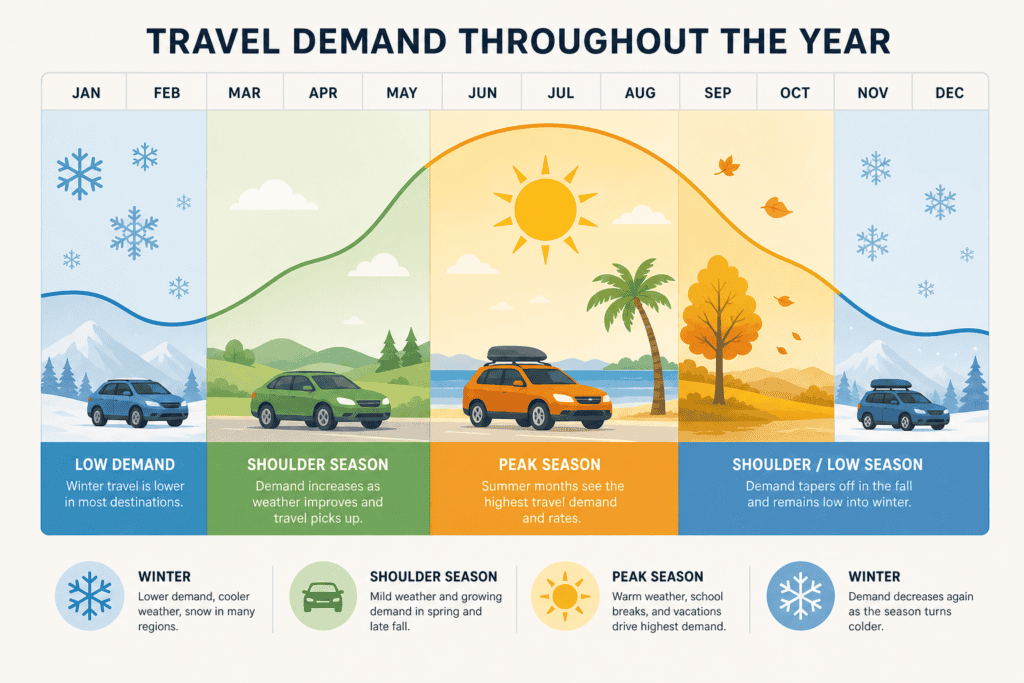
Why does the same rental car cost noticeably more during certain weeks of the year and less during others? The answer lies in demand cycles. Travel patterns rise and fall throughout the year, and rental companies often adjust pricing as bookings, fleet availability, and expected demand change. Understanding these cycles can help you anticipate cost swings and time your booking more strategically.
Quick Answer
Peak car rental pricing typically occurs when travel demand is high relative to available vehicles, such as during major holidays, school breaks, or popular tourist seasons. Off-peak pricing tends to appear when demand is comparatively lower and fleets have more unused availability. These patterns are not identical everywhere, and a destination’s off-peak period can still involve tight vehicle availability depending on local events or seasonal tourism.
This concept connects closely to the broader topic of car rental pricing explained, since seasonal demand is one of several forces that shape what you eventually pay.
What “Peak” and “Off-Peak” Actually Mean
Peak and off-peak are not fixed calendar dates that apply universally. They describe periods of relatively higher or lower travel demand for a specific location. A beach destination’s peak season may fall in summer, while a ski destination’s peak may fall in winter. A convention city might see a demand spike tied to a specific event rather than a season at all.
Because demand is local and situational, the same week can be “peak” in one city and “off-peak” in another. This is one reason how location affects car rental prices is a separate consideration from seasonal timing, even though the two often interact.
Why Rental Prices Respond to Peak and Off-Peak Demand
Rental companies maintain a limited fleet at each location. When many travelers want vehicles during the same window, remaining inventory shrinks and pricing may rise as availability tightens. During lower-demand periods, more vehicles may sit unused relative to demand, which can create room for more competitive pricing.
This is a demand-and-availability relationship, not a guaranteed formula. A location experiencing an unexpected event, a local festival, or a temporary fleet shortage can still see elevated pricing during what is normally considered an off-peak stretch. For a deeper explanation of how these adjustments may happen, see how car rental pricing works behind the scenes.
Common Peak-Demand Periods
- Major national holidays and long weekends
- School breaks and summer vacation months
- Popular tourist seasons specific to a destination
- Large conventions, festivals, or sporting events
- Weekends in leisure-heavy markets
Common Off-Peak Periods
- Weeks immediately after major holidays
- Shoulder seasons between a destination’s high and low tourism periods
- Weekdays in markets driven mainly by weekend leisure travel
- Months outside a location’s primary tourist season
For a closer look at specific lower-demand windows, see cheapest months of the year to rent a car.
Shoulder Periods: The In-Between Zone
Shoulder periods sit between peak and off-peak demand. They often show more price variability because demand is less predictable than during a clear peak or a clear lull. A shoulder week might behave like an off-peak period one year and shift closer to peak pricing the next, depending on events, weather, or broader travel trends.
Because of this variability, shoulder periods can sometimes offer a useful middle ground: lower demand than true peak season, but with more travel options still available than during the deepest off-peak stretch.
Vehicle Category Availability During Peak and Off-Peak Periods
Demand does not affect every vehicle category equally. During peak periods, popular categories like SUVs, minivans, and full-size vehicles may sell out faster, leaving primarily economy or premium options. During off-peak periods, a wider mix of categories may remain available, sometimes creating opportunities to book a larger vehicle at a more moderate price.
This is why a smaller car is not automatically the cheaper choice in every scenario. Explore this further in rental car types explained.
Example: Peak vs Off-Peak Pricing Comparison
The following illustrative example shows how the same vehicle category might price differently across two demand periods. These numbers are hypothetical and used only to demonstrate the pattern, not to represent actual current rates.
| Scenario | Estimated Base Rate | Vehicle Availability | Traveler Consideration |
|---|---|---|---|
| Peak holiday week | $85/day | Limited; popular categories may sell out early | Book earlier; compare categories if your first choice is unavailable |
| Shoulder period | $58/day | Moderate; some categories still selling | Some flexibility on pickup/return time may help pricing |
| Off-peak week | $40/day | Broader; more categories may remain open | Good opportunity to compare upgraded categories at moderate cost |
Remember that a lower base rate does not automatically mean a lower total. Taxes, location charges, and optional products still apply regardless of season. For a full breakdown of those additions, see car rental taxes and extra charges explained.

Destination Differences Matter
Peak and off-peak timing varies by destination type. A business-travel city may see its slowest demand during summer vacation months and its busiest periods during weekday conventions. A beach or resort destination often follows the opposite pattern, with summer or winter holiday weeks driving the highest demand depending on climate.
Travelers researching a specific market may want to review local rental options directly, such as car rentals in Orlando, car rentals in San Juan, or car rentals in Montego Bay, since seasonal demand patterns can differ meaningfully between a convention-driven city and a tourism-driven destination.
Common Myths About Peak and Off-Peak Pricing
Myth: Off-peak periods are always cheaper everywhere
Not necessarily. A location can experience a local event, festival, or unexpected demand spike that pushes prices up even during what is typically a slower season.
Myth: Peak season pricing is identical across all destinations
Peak timing is destination-specific. A ski town’s peak differs from a beach town’s peak, and both differ from a business-travel city’s peak convention weeks.
Myth: Waiting until closer to pickup during peak season will lower the price
During high-demand periods, waiting can sometimes mean fewer vehicles remain, which may push prices higher rather than lower. For more on this timing dynamic, see do car rental prices go up closer to the date.
Before You Book
- Identify whether your travel dates fall during a known peak period for your destination, such as a holiday or major local event.
- Compare pricing for a few different vehicle categories rather than assuming the smallest option is cheapest.
- Check whether nearby shoulder dates offer more moderate pricing.
- Review the full estimated total, not just the advertised base rate.
- Consider whether flexible or refundable rate options are worth the potential price difference. See should you prepay for a rental car for more on this trade-off.
- If your destination has strong tourism seasonality, review best time to book car rentals for broader timing guidance.
- Compare a few rental locations if your destination has multiple pickup points, since demand may vary by location.
Frequently Asked Questions
Is off-peak always the cheapest time to rent a car?
Usually, but not guaranteed. Off-peak periods generally see lower demand and more available inventory, but local events, temporary fleet shortages, or other factors can still raise pricing even during a typically slower season.
How far in advance should I book during peak season?
There’s no universal rule, but booking earlier during high-demand periods may help secure your preferred vehicle category before availability narrows. For more on timing strategy, see best time to book car rentals.
Do all destinations share the same peak season?
No. Peak timing depends on the type of destination and the travel patterns specific to that market. A resort area’s peak can differ significantly from a city driven by business travel or conventions.
Can prices still rise during a typically off-peak week?
Yes. A local event, festival, or short-term surge in demand can temporarily tighten availability even in a location’s normal off-peak window.
Does peak season affect all vehicle categories equally?
Not necessarily. Popular categories like SUVs or full-size vehicles may become limited first during high-demand periods, while other categories may remain more available. See rental car types explained for more detail.

The Bottom Line on Peak and Off-Peak Rental Pricing
Peak and off-peak pricing reflects how travel demand rises and falls for a specific destination, not a fixed calendar rule that applies everywhere equally. When demand is high and vehicle availability tightens, prices often increase. When demand eases, pricing may become more flexible, though local events can still create exceptions. Comparing vehicle categories, reviewing full estimated totals, and understanding your destination’s demand pattern can help you make a more informed booking decision. For the broader picture of how these seasonal shifts fit into overall pricing behavior, revisit car rental pricing explained or explore why car rental prices change frequently.
Ready to Compare Airfares?
Compare current prices and availability before you book—fares can change quickly.
Search Flight Deals →