
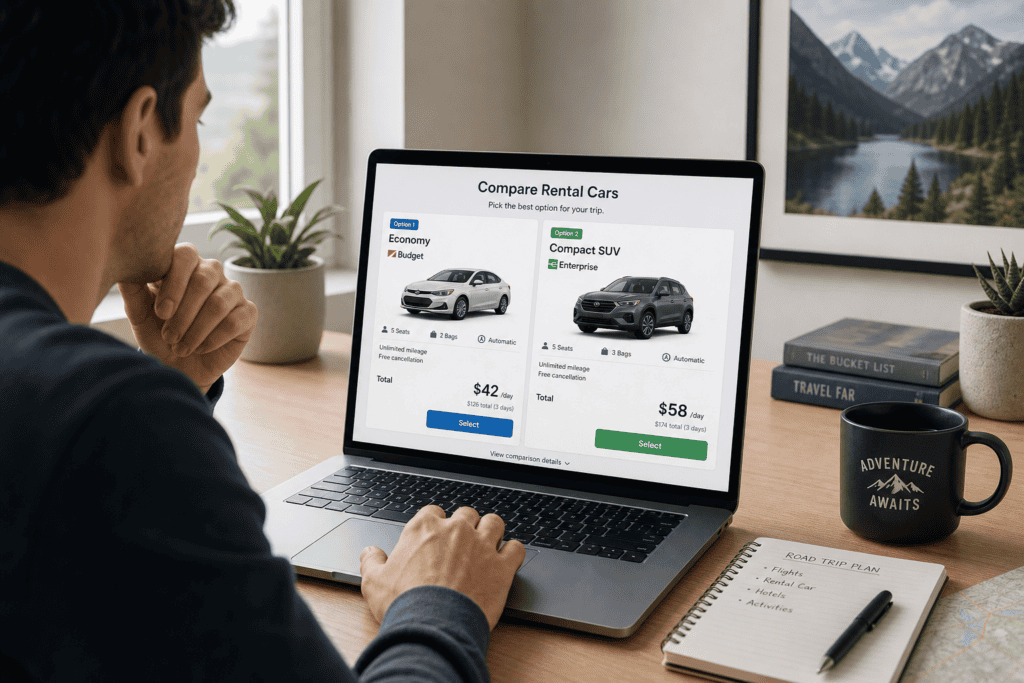
Once you’ve searched for or reserved a rental car, the price you saw doesn’t necessarily stay fixed. Rates can move up, down, or stay flat depending on demand, inventory, and how far away pickup day is. If you’re wondering whether it’s worth checking back on a rental price — and how to do that without accidentally losing your reservation — this article walks through a practical way to track rental car prices over time.
Quick Answer
You can track car rental price drops by rechecking the same pickup location, dates, vehicle class, and cancellation terms at regular intervals, using price-alert tools where a rental company or booking platform offers them, and setting simple calendar reminders. There’s no guarantee a lower price will appear, but monitoring puts you in a position to notice one and act on it if it does.
Why Rental Prices Can Change After You Search or Book
Rental companies frequently adjust rates using dynamic pricing systems that respond to remaining vehicle inventory, booking pace, local events, and shifting demand. This means the price for the exact same dates and vehicle category can look different tomorrow than it does today — sometimes higher, sometimes lower, and sometimes unchanged for days at a time.
Because pricing is not static, a single search only captures a snapshot. If you want to know whether a better rate becomes available, you generally need to check back rather than assume the first quote you see is final.
Setting Up a Simple Price-Tracking Routine
You don’t need complicated tools to monitor rental prices effectively. A basic routine tends to work well for most travelers:
- Save the exact search details: pickup location, pickup date and time, return date and time, and vehicle category.
- Take a screenshot or note the total price, including taxes and mandatory fees.
- Set a calendar reminder to recheck the same search every several days, or on a schedule that fits your trip timeline.
- Check again closer to pickup, since availability and pricing can shift more noticeably as the date approaches.
- Keep a simple log — even a notes app entry — showing the date you checked and the price you found.
If you already hold a reservation, this routine also lets you compare any new price against your existing one instead of relying on memory.
Using Price-Alert Tools When Available
Some booking platforms and travel search tools offer price-tracking or alert features that notify you when a rate changes for a saved search. If a tool like this is available to you, it can reduce the manual work of rechecking rates yourself. Confirm exactly what the alert is comparing — some tools track a general route or region rather than your specific pickup location, dates, and vehicle class, which can lead to alerts that aren’t truly apples-to-apples with your reservation.
What to Compare Every Time You Recheck a Price
A lower number on the screen isn’t automatically a better deal. Before treating a new quote as a genuine price drop, compare it against your saved search or existing reservation using the same conditions:
- Same pickup and return location
- Same pickup and return date and time
- Same vehicle category (not just a similarly named one)
- Same mileage allowance
- Same fuel policy
- Same cancellation and payment terms
- Same driver age and any related fees
- Total price including taxes and mandatory charges, not just the base rate
Two quotes that look similar on the surface can differ in mileage limits, fuel policy, or cancellation flexibility. When you want a deeper walkthrough of comparing offers correctly, see how to compare car rental prices the smart way.
Hypothetical Example: Tracking a Price Over Several Weeks
The following scenario is illustrative only and does not reflect real current rates.
Suppose a traveler books a refundable midsize car for an upcoming trip and saves the total price at $340 for a five-day rental. Ten days later, while rechecking the same pickup location, dates, and vehicle category, the same reservation type shows a total of $305. Before changing anything, the traveler confirms:
- The vehicle category is genuinely equivalent, not a smaller class
- The pickup and return times match exactly
- The cancellation policy on the new offer is at least as flexible
- The total price, including taxes and fees, is actually lower
Only after confirming these details would it make sense to consider securing the lower-priced option — and only after a replacement reservation is confirmed, not before. Deciding what to do once a genuine drop appears is covered separately when you’re ready to weigh the timing of a book-now-or-wait decision.
How Often Should You Recheck Rental Prices?
There’s no fixed interval that works for every trip. How often it makes sense to check tends to depend on how far out your pickup date is and how much flexibility your reservation allows.
| Situation | Checking More Often May Help | Checking Less Frequently May Be Fine |
|---|---|---|
| Pickup is many weeks away | Not usually necessary yet | Occasional checks are typically enough |
| Pickup is within one to two weeks | More frequent checks can catch late changes | Less useful if your dates or vehicle needs are inflexible |
| You hold a fully refundable reservation | Rechecking has low downside | Still worth occasional review |
| You hold a prepaid, non-cancelable rate | Rechecking mainly for awareness | Rebooking may not be possible regardless of price |
This table is meant to guide your effort, not promise that a lower rate will appear on any particular schedule.
Airport Pickups and Price Monitoring
If your pickup point is an airport location, keep in mind that inventory and pricing can move differently there than at a neighborhood counter, partly due to flight demand, airport-specific charges, and shuttle or counter operating hours. When you’re tracking prices for an airport rental, it helps to check the exact terminal or rental center you plan to use rather than a general city search. For a closer look at how airport pickups work, see airport car rentals.
When a Tracked Price Drop Is Worth Acting On
Not every dip in displayed price is meaningful. A drop is more likely worth pursuing when it reflects the same vehicle class, same location, same dates, and equal or better cancellation terms — and when the savings are large enough to justify the effort of rebooking. If you do find a genuine, verified lower rate on a flexible reservation, the general sequence to follow is:
- Confirm the new offer matches your existing reservation on every relevant detail.
- Secure the new reservation first.
- Only then cancel the original reservation, if your terms allow it.
Canceling an existing reservation before a replacement is confirmed can leave you without a vehicle if the new rate disappears or the class sells out in the meantime.
Common Myths About Rental Price Tracking
- “Prices always drop if you wait long enough.” Prices can move in either direction, and waiting carries its own availability risk.
- “A price-alert tool guarantees you’ll catch every drop.” These tools can help, but they may not track your exact vehicle class, location, or terms.
- “Any lower number is a better deal.” A lower price with a stricter cancellation policy or smaller vehicle class isn’t a true apples-to-apples improvement.
Before You Book
- Save your exact pickup location, dates, times, and vehicle category for future comparisons.
- Record the full price, including taxes and mandatory fees, not just the base rate.
- Choose a refundable reservation if you want the option to rebook later.
- Set calendar reminders to recheck prices at reasonable intervals.
- Use a price-alert tool where available, but verify what it’s actually comparing.
- Before acting on a lower price, confirm every term matches your current reservation.
- Secure any replacement reservation before canceling your original one.

Frequently Asked Questions
Can I track rental prices without an alert tool?
Yes. Manually rechecking the same search — same location, dates, and vehicle class — on a regular schedule works well and gives you full control over exactly what’s being compared.
Will rechecking prices ever hurt my existing reservation?
No. Simply searching or comparing prices does not affect a reservation you’ve already made. Changes only happen if you actively modify or cancel it.
How do I know if a lower price is a real improvement?
Compare the total price, vehicle category, mileage allowance, fuel policy, and cancellation terms side by side. A lower number with weaker terms may not be a genuine improvement.
Is it worth tracking prices on a prepaid reservation?
You can still watch prices for awareness, but many prepaid rates carry limited or no cancellation flexibility, so a lower price found later may not be something you can act on.
Should I track prices differently for airport pickups?
It can help to check the specific airport or rental center rather than a broad city search, since airport inventory and demand can behave differently than off-airport locations.
Making Rental Price Tracking Work for You
Tracking car rental price drops isn’t about guessing a magic day or hour to check — it’s about consistently comparing the same location, dates, vehicle class, and terms over time so you can spot a genuine change when it happens. Keep your reservation flexible where possible, verify every detail before switching offers, and always confirm a replacement reservation before canceling the one you already hold. Used this way, monitoring becomes a practical habit rather than a guarantee of savings.
Ready to Compare Airfares?
Compare current prices and availability before you book—fares can change quickly.
Search Flight Deals →